

Employee satisfaction survey
What is satisfaction?
Satisfaction
is an index that shows how satisfied an employee is with his/her job and basic working conditions.Satisfaction is the foundational baseline of engagement. Employees cannot be engaged if they are dissatisfied with their salary, working conditions, job content, etc. These factors, also known as hygiene factors, affect engagement only when they are negative. Conversely, with high satisfaction, further improvements in these factors alone do not lead to a significant increase in engagement.
What are the consequences of a low gauge
Low satisfaction acts as a direct roadblock to engagement. Therefore, a company may face the following problems:
- Loss of customers and decrease in revenue. Employees will be indifferent to customer needs and won't delve into the product's features or how it compares to competitors. As a result, departments with low satisfaction lose 26% more customers than departments with satisfied employees, according to a contract survey by Happy Job.
- Increase in production losses.. Also, according to statistics, employees in this case are 41% more likely to make mistakes at work and 48% more likely to become victims of accidents at work.
In addition to direct financial risks, there are negative effects that are difficult to assess but affect the company's operations and results:
- Enormous control. Managers are forced to oversee dissatisfied subordinates, as they are prone to making mistakes. This oversight takes up time that could otherwise be spent on team development, making important management decisions, etc.
- Lack of trust. Instead of working, people will be busy sorting out their relationships. This will inevitably impact the quality of teamwork and employee initiative.
- Bureaucracy. No one in the department is working on process improvement. This will result in a bloated reporting system and poorly streamlined processes.
What factors impact
Five factors have the biggest impact on employee satisfaction. Let's consider them.
Labor compensation
Pay is one of the main motivators for work. If someone feels they're not being paid enough for their work, their productivity will drop or they'll look for a new job.
The Happy Job platform uses Compensation metric to assess this factor.
Benefits
Poor quality or insufficient benefits can result in lower employee satisfaction and productivity.
The Happy Job platform uses Benefits metric to assess this factor.
Job content
When employees are interested in the content of their work, they enjoy doing it. Interest in work directly impacts engagement and satisfaction.
According to a Happy Job survey the interest in tasks performed unlocks a natural drive to develop and apply a wide, versatile set of skills.
The Happy Job platform uses Interest metric to assess this factor.
Work safety
Neglecting employee safety directly stifles productivity. People need to feel that their health is being taken care of.
The Happy Job platform uses Safety metric to assess this factor.
Working conditions
Physical work environments heavily dictate employee satisfaction. For example, the temperature and noise level in the office. Heat, cold, or noise levels can lead to decreased concentration and, consequently, increased error rates.
The Happy Job platform uses Working conditions metric to assess this factor.
Happy Job survey
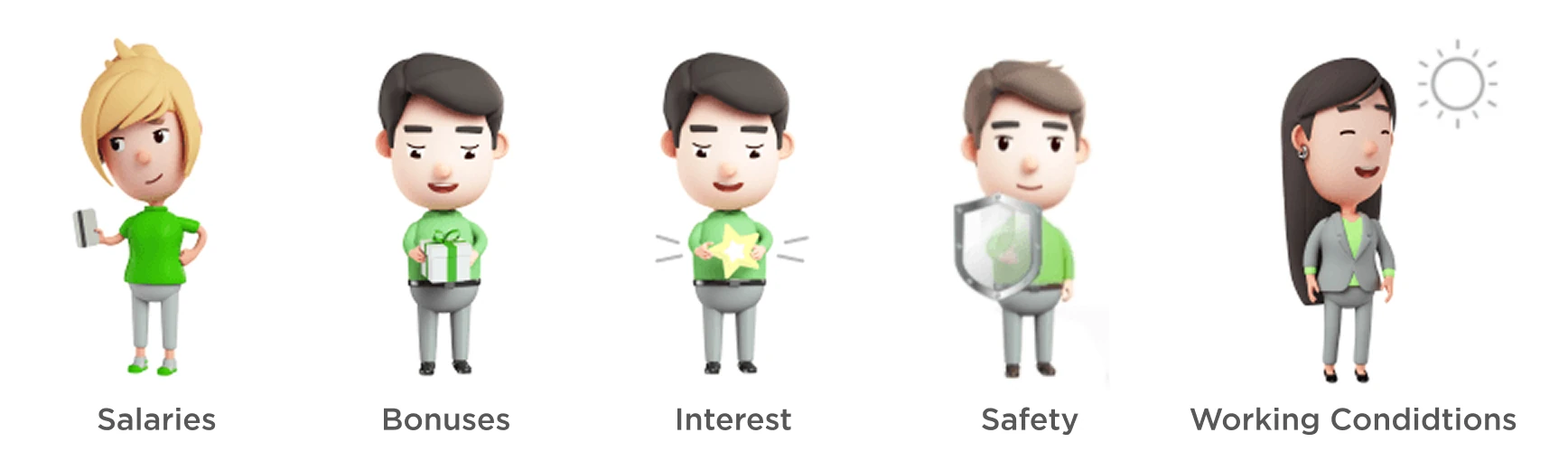
On the Happy Job platform, employee satisfaction is assessed using five metrics: "Compensation," "Benefits," "Interest," "Safety," and "Working Conditions," which are submetrics of the engagement metrics "Working conditions and compensation" and "Workflows."
Each metric has its own question, the answers to which generate a score from 1 to 10. The arithmetic mean for all five metrics is an indicator of employee satisfaction.
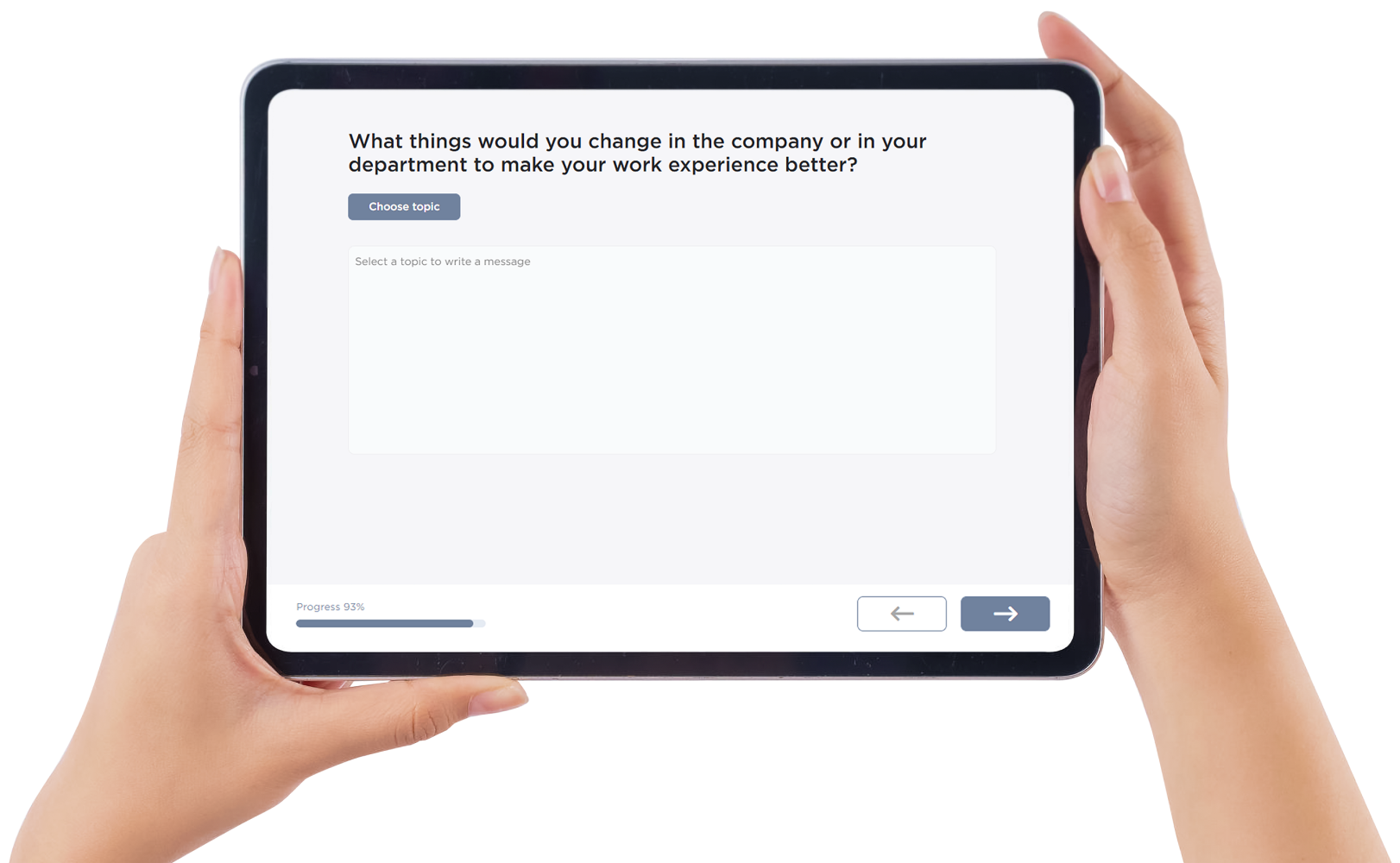
Finding out what
employees think is

Satisfaction groups
Depending on their responses, employees can be divided into three groups according to their level of satisfaction: high, medium and low.

High satisfaction
This group includes people with an average satisfaction score of 9 or higher. They are generally satisfied with their working conditions and compensation. If the company has a productive work environment, they will demonstrate high work engagement.
Medium satisfaction
This group includes employees with an average score of 7 or higher, but less than 9. They are generally satisfied with the working conditions, but may actively consider another job.
Low satisfaction
This group consists of employees with an average score below 7. Employees in this group are dissatisfied with their working conditions, salary, and job content. Even in a productive work environment, they will show low engagement.
How to improve employee satisfaction
The Happy Job platform provides recommendations for improving employee satisfaction survey results.
Let's look at the Interest metric as an example.
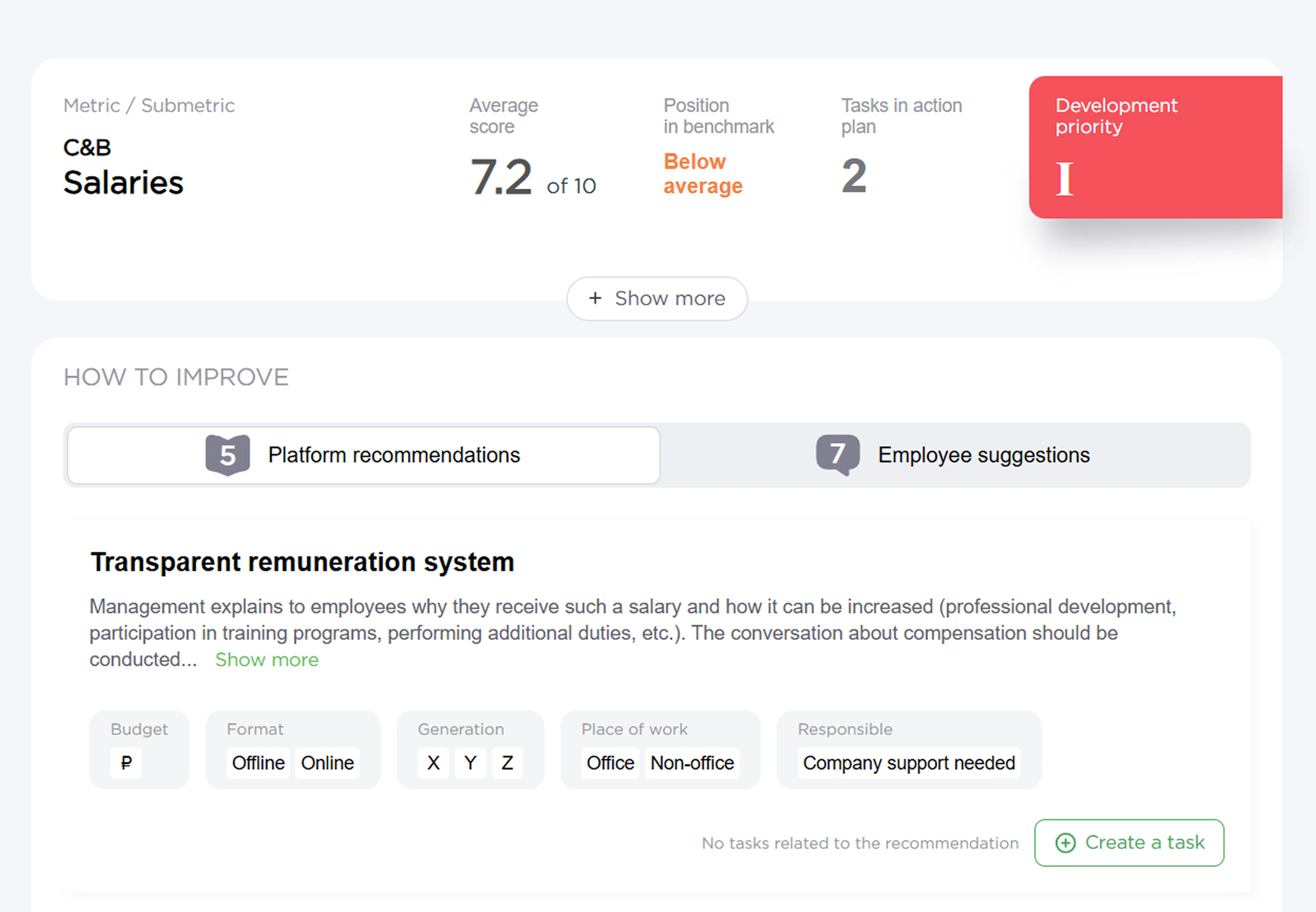
To improve metric performance, the platform provides standard measures that can be added to an action plan. This way, the manager will be able to see what actions they have chosen to improve the metric, what they have already accomplished, and what they haven't yet.
By implementing the measures proposed by the Happy Job platform, you can significantly increase the employee satisfaction rate for the reporting period.