
eNPS

What is eNPS?
The eNPS metric, or Employee Net Promoter Score, is a streamlined HR metric of two important aspects of corporate culture and a company as a whole: the most important aspect of employee loyalty - satisfaction with working conditions and readiness for changes.
The eNPS metric is measured by asking employees how likely they are to recommend working for the company to their friends. Employees rate on a scale of 0 to 10, where 0 is no and 10 is yes. Based on these ratings employees are categorized as Promoters, Passives, and Detractors.
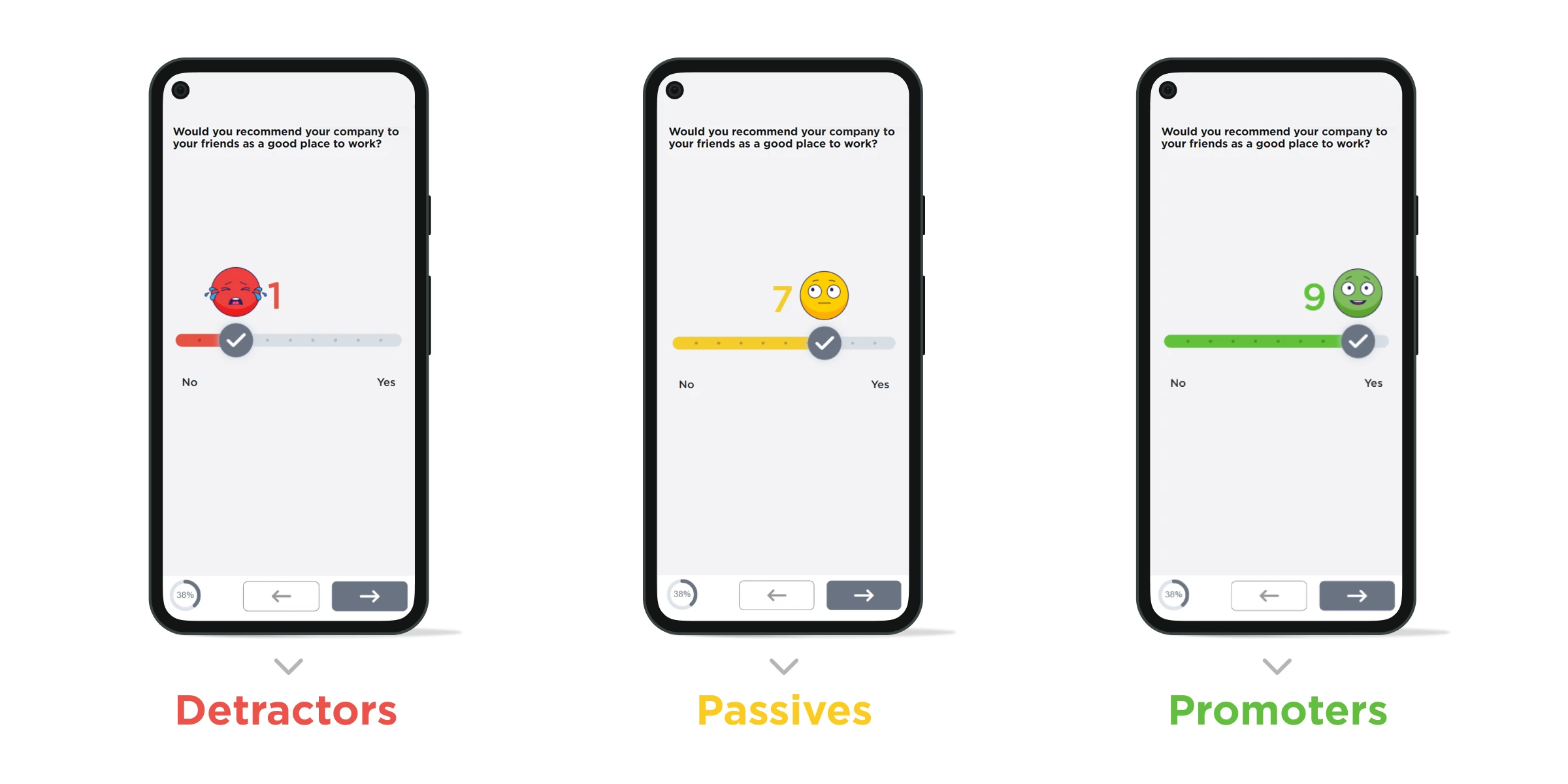
Promoters (Scores 9–10).
These are highly engaged and loyal employees who are ready to support any changes, open to new experiences and projects, and will grow professionally.
Passives (Scores 7–8).
These employees are generally satisfied with the company's conditions; they do their job well as a mere formality, but without striving to make the result as good as possible. Passives will support any changes if a manager convinces them of the need to implement innovations.
Detractors (Scores 0–6).
These are unhappy, disengaged employees. They tend to openly criticize processes and culture. Dissatisfaction can impact work quality—employees perform their duties perfunctorily. They don't want to change anything and won't support change. It's important to establish contact with this category of employees: find out the cause of their disappointment and try to improve the situation.
Detractors are an important asset of the company – they have the courage to point out real problems.
That's how it all got started
In the mid-2000s, Apple managers derived the eNPS index from the NPS index, which F. Reichheld had adapted several years earlier from a well-reputed psychological test. The original NPS methodology asked customers to rate their willingness to recommend a company's brand or product to friends on an 11-point scale.
The traditional 0-to-10 Net Promoter Score (NPS) scale is an 11-point metric. Telephone interviews and surveys used to heavily rely on 0 to 10 rating scales. In survey design, researchers use 0-based scales because everyday habits condition people to instinctively view 1 as "number one" or the top grade. This means that when the scale ranges from 0 to 10, it requires more effort and time from the respondent to understand and ensures reliability. Psychometric research data indicate that labeled scales with emoticons for conveying emotions for responses are the most reliable questionnaire. Without labeled answer scales, it can cause confusion and reduce respondent participation due to a lack of understanding of the scale (e.g. what is the difference between 6 and 7), and also increasing the time to complete.
In eNPS, the method for calculating the index remained the same, but the main question was changed: “How likely is it that you would recommend the company as an employer to your friends?”.
How to gauge Employee Net Promoter Score
Gauging eNPS is quite simple and is shown in the diagram below.
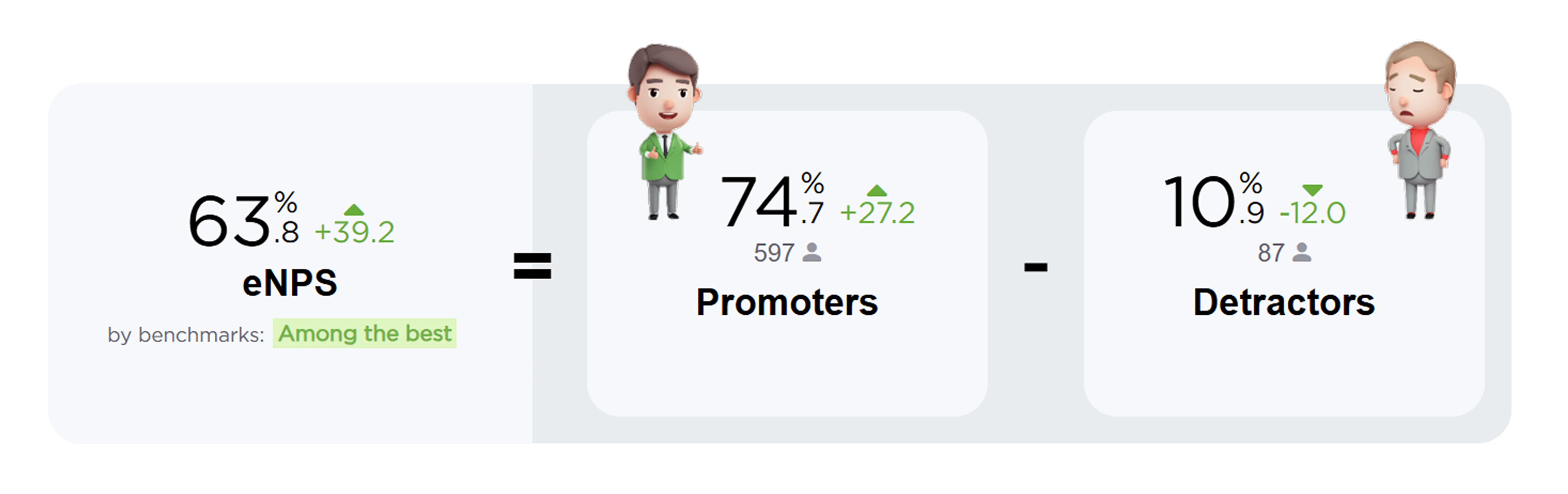
- Survey your staff asking the question: “How likely is it that you would recommend the company as an employer to your friends?”.
- Categorize Your Responses – promoters, passives, detractors (on a scale above).
- Determine the total number of employees who participated in the survey. To do this, add up the number of promoters, passives, and detractors.
- Calculate the percentage of promoters and detractors.
- Subtract the share of detractors from the share of promoters.
- The result of the subtraction will be your employee eNPS.
We assume a loyalty survey shows that your company has 70 promoters, 30 detractors, and no passives. Then the share of promoters is 70%, detractors 30%, and the eNPS is:
70% − 30% = 40%.
Let's see what happens if the company employs 50 more passives. Headcount is:
70 + 30 + 50 = 150.
The share of promoters is 47%, the share of detractors is 20%. Then the eNPS is:
47% − 20% = 27%.
In the second case, eNPS dropped significantly. This is why companies should pay attention not only to detractors but also to passives, ideally turning as many of them as possible into promoters.
In addition, we emphasize that detractors should be viewed as opportunities for growth rather than enemies!
These aren't "bad" employees, but just as much a company asset, often good professionals. They are not afraid to be out on a limb, and managers shall work to purposefully increase the loyalty of such employees.
Why to gauge eNPS
A high eNPS score indicates satisfaction with the company's conditions. It goes without saying that employee relations are key to the success of any business.
Utilization of eNPS index to assess employee loyalty has been confirmed by a number of studies. In the seminal 2015 Harvard Business Review article, "How Company Culture Shapes Employee Motivation," authors found a correlation between high company index scores and employee sales success: in retail, loyal salespeople made an average of 30% more sales, and in the banking sector, 34% more.
Today, the employee loyalty index can quite accurately predict the success of implementing changes in a company: the higher the eNPS, the greater the chance that the team will accept the changes and not stonewall them, since employee satisfaction is an indicator of employee sentiment and readiness to accept new things.
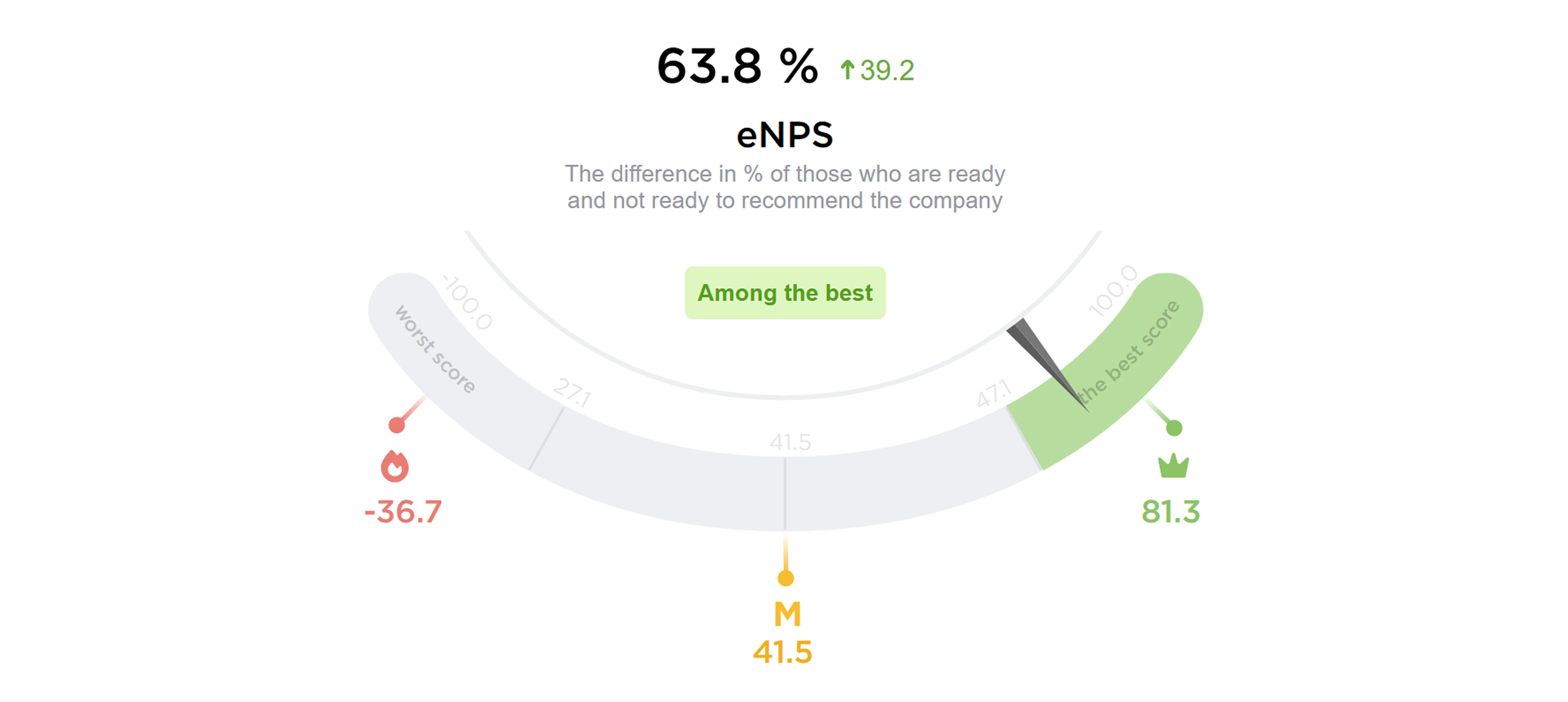
The eNPS metric also impacts other aspects of a company's performance. Promoters are not just satisfied, loyal employees. They help attract new people, potential "stars," to the company through word of mouth and recommendations from the HR brand. As a result, the company's costs for finding and attracting specialists are significantly reduced.
Loyal employees do more to attract valuable talent than the most attractive job adverts, so it's important to continually monitor eNPS and take the right actions to improve it.
A well-designed loyalty survey makes you not only to determine your eNPS, but also to understand the underlying factors and what influences it. This information can be used as a starting point when developing loyalty-building initiatives.
How to improve eNPS
Improving your eNPS is a system of activities and an ongoing process that requires careful planning and implementation.
Below are five sequential steps that can quickly change the dynamic to a positive one. However, this list can be extended further, and you can find more tips and recommendations from experts on our Happy Job platform.
1. Study proposals by passives and detractors
You should start working on improving the eNPS metric by reading the proposals of passives and detractors through feedback and anonymous comments. By listening to the causes of employee dissatisfaction and addressing them, you can turn some passives and detractors into promoters.
2. Make a list of indicators to improve the metric
Identify the metrics that need to be impacted first. These may include:
- - managerial competencies that can be assessed by conducting a survey of employees about the manager;
- - compensation and working conditions;
- - communication efficiency;
- - distributing the workload on team members;
- - communicating the team about the company's existing incentive systems, benefits, and social privileges;
- - management's attention to the needs of employees in abnormal conditions.
3. Act through your manager
It is important for each manager to find out the reasons for dissatisfaction in his/her department. These can be determined by examining the results of an anonymous online survey. These could include, for example, working conditions, process deficiencies, or a lack of career development. These identified issues should then be raised and discussed in team meetings and one-on-ones.
4. Arrange meetings and workshops to gather ideas for improving eNPS
Individual meetings and team workshops will allow employees to gather ideas on how to improve departmental work and find solutions to identified problems.
5. Implement measures and report on results
Amazing fact that simply "doing" is not enough. It is also necessary to keep employees informed: report on progress, interim and final results at team meetings. If these measures have not helped resolve the department's problems, take a step back and start collecting ideas again during the next survey.
We want also to list general recommendations for improving eNPS.
- Make it easy for your employees to recommend your company. Useful tools for this include: brand media, printed materials, and a referral system as part of hiring.
- Reduce the average time to resolve issues. Offer temporary solutions during the transition period while improvements are not yet implemented.
- Engage all managers. Ensure that managers at all levels of your company are committed to strengthening employee loyalty. 70-80% of the success in improving eNPS depends on managers.
- Monitor eNPS continuously. This metric is not created overnight and is constantly changing. Set up ongoing feedback to measure, assess, analyze, and improve your eNPS, for example, through further engagement and loyalty surveys.
When and how often to measure eNPS
We generally recommend to do it at regular intervals. Furthermore, at Happy Job, we recommend assessing eNPS, along with other HR metrics, as part of an engagement and loyalty survey at least twice a year.
Creating a survey schedule is essential, of course, considering your company's business rhythms: seasonality and peaks in business activity. When scheduling your personnel survey, it's important to balance your survey schedule so as to:
- maintain employee participation;
- give managers time to implement changes;
- develop a sustainable culture of continuous feedback within the company.
Benefits of measuring and assessing eNPS
Here are five reasons to include this metric in your regular engagement and loyalty surveys.
Regularization of relationships with your employees
Metric lets you know what your employees think about your company or brand. This bridges the gap between your abstract ideas and the real situation. Employees may be dissatisfied with their working conditions or the expertise of their managers. By identifying this, you can intervene promptly and correct the situation.
Improving corporate culture and team atmosphere
With loyalty surveys that include eNPS and mNPS (i.e., manager NPS) assessments, you can identify which departments require more attention, where passives and detractors predominate, and then propose measures to overcome negative attitudes.
Business Health Assessment
A low employee loyalty rate indicates that your business, corporate culture, and HR brand are headed in the wrong direction. A large number of disloyal employees increases a company's business risks: turnover increases, information leaks and customer loss are more frequent, valuable and rare talent is less likely to join the company, and retaining them is more expensive.
A "view from above" and understanding the big picture
While loyalty metrics such as Proud of the company, Willingness to remain now, Remains in the future, and Committed to doing more are focused on short-term periods (employees answer questions based on their feelings “at some point”), eNPS helps you see the big picture, as willingness to advocate for their workplace is a long-term and complex parameter.
Development of referral recruitment
A picture is worth a thousand words. Employees who advocate for their workplace help valuable candidates see all the benefits of working at your company. Surveys show that employees who join companies through recommendations from friends and family are more likely to stay long-term.
Next Steps
The golden rule of eNPS is to always take action after calculating scores and analyzing the results. This could include activities to strength loyalty, train managers in essential competencies, or simply thank employees for their time to provide honest feedback.
The right timing
Do not overload your employees with eNPS surveys: incorporate them into your semi-annual and quarterly event planning for engagement and company culture. Establish a predictable, routine survey cycle and share the survey schedule with employees in advance.
Monitoring progress
Don't stop after the first survey. How the eNPS score changes over time is just as important as its numerical value. A decline in eNPS is a sign that your HR strategies need to be reconsidered and refined.
How to conduct segmentation analysis
When analyzing eNPS data, do it right. Companies often have a dataset but don't know how to use it effectively. So, filter responses based on specific parameters and anonymous comments to understand the root causes of why employees like or dislike your company.
Key Platform Features to measure eNPS
Using a dedicated platform helps understand not only the index level but also all the factors that influence it. Unlike online or paper-based eNPS questionnaires, a survey and research platform simplifies and accelerates the assessment process.
It must meet the following requirements.
-
Full automation of measurement and assessment
The entire eNPS process from launching the initial communication with respondents, completing the survey, to analyzing and visualizing the results should be automated. Manually measuring and assessing metrics by HR specialists is a waste of time and money, and mistakes are inevitable.
-
Anonymity of employee surveys
An eNPS platform shall guarantee 100% anonymity and data protection for respondents, so that people can be confident that their data won't be disclosed to managers. Failure to guarantee and ensure anonymity will result in a loss of trust and obtaining socially expected responses that are useless to managers.
-
Gamification, simplicity and convenience of completing surveys
The platform you choose should make the survey process an engaging experience or game. Employees should be able to answer questions at their own convenience.
-
Personalization of surveys
The platform you choose should create personalized surveys tailored to the company's business, employee profile (office, non-office).
-
In-depth analytics
An eNPS platform should include analytical tools for managers to maximize the survey value. For example, the Happy Job platform offers content analysis of comments (grouped for visual convenience), categorization by specific topics, and a variety of filtering options that allow for drilling down into the numbers and responses of individual departments.
-
Scheduling and tracking tools
An eNPS platform should provide the ability to build an action plans within the system. Managers at all levels must have access to data so they can independently set priorities and then develop engagement and loyalty based on the information obtained from survey.
Looking for an eNPS platform for your business?
Start or continue your journey to success with Happy Job. This intuitive engagement and loyalty survey platform effectively collects eNPS data from employees, analyzes it in depth, provides critical insights to managers, and enables targeted metric improvement and increased engagement of promoters within a company.
You can choose from flexible pricing plans, and our consultants are always ready to assist you. To objectively assess the situation with eNPS in your company, you can use up-to-date and accurate benchmarks based on our client surveys.
eNPS FAQs
What is a good engagement and loyalty survey participation rate (including eNPS)?
For the survey results to be considered valid, at least 61% of employees must participate. Surveys on the Happy Job platform are simple and clear, enhanced with visualization and gamification elements. This results in an average employee participation rate of 83%.
How to increase survey participation rate?
The key factor is ease of participation: employees should be able to answer questions at any time and on any device.
You should avoid sending surveys to the same respondents multiple times - the Happy Job platform has a security mechanism that prevents duplicate surveys.
We recommend to distribute surveys evenly throughout the year so as not to overload employees.
To increase employee engagement, conduct a preliminary PR campaign. After completing the survey, arrange activities to improve the situation - this will help maintain the team's trust.
What are Net Promoter Score Pitfalls?
The eNPS metric reflects employee opinions of the company, but doesn't indicate what specifically needs to be changed. To determine the key factors influencing the index, it is necessary to conduct a comprehensive employee engagement and loyalty survey.