
mNPS

What is mNPS?
It is a known fact that managers can both compensate for the company's shortcomings and, conversely, strengthen them.
What would your employees say if you asked them to recommend the company and their direct manager separately?
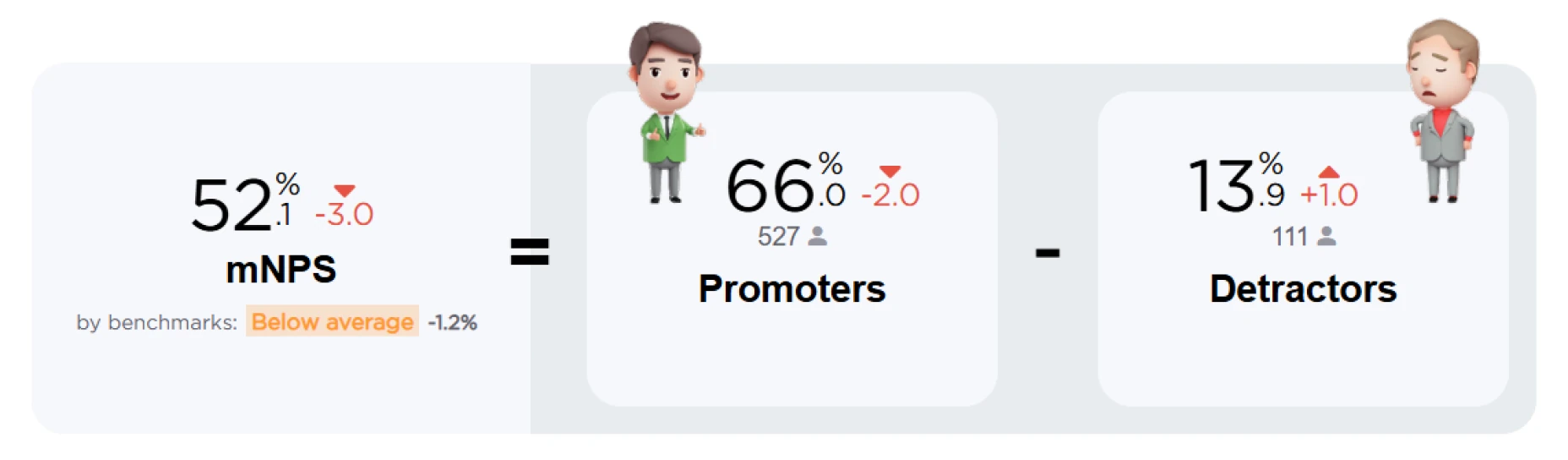
mNPS is a focused loyalty metric that shows how likely employees are to recommend working with their direct manager to friends and family.
It asks workers: Based on your experience, how likely are you to recommend your direct manager as a good leader to a friend or relative?. Employees rate on a scale of 0 to 10, where 0 is no and 10 is yes. Based on these ratings employees are categorized as Promoters, Passives, and Detractors.
Promoters (Scores 9–10).
Promoters are ready to support any managerial initiatives, are open to new experiences and high-quality feedback, and enthusiastically accept new projects and changes proposed by the manager.
Passives (Scores 7-8).
Passives are generally satisfied with the manager, but they perform the tasks set by him without enthusiasm, and do not strive to exceed expectations. Passives will participate in projects to the extent possible if the manager convinces them of the feasibility and personal benefit of participation; they will support changes if, through the manager's encouragement, they are convinced that the innovations are necessary.
Detractors (Scores 0-6).
Detractors are dissatisfied with the manager: this assessment can be both impartial ("he is not a professional") and subjective ("I do not like him"). They typically confront the manager openly at meetings and conferences, criticizing him/her behind the backs, among colleagues, and in close circles. Dissatisfaction with the manager can impact the quality of work. Detractors will not support changes if initiated by a manager.
Detractors are a valuable asset to a company—they have the courage to point out a leader's genuine lack of managerial skills. You should establish contact with this category of employees: find out the cause of their disappointment and try to improve the situation.
How to gauge employee mNPS
This is quite simple to measure mNPS.
- Survey you staff with the question: “Based on your experience, how likely are you to recommend your direct manager as a good leader to a friend?”.
- Categorize Your Responses – promoters, passives, detractors (on a scale above).
- Determine the total number of employees who participated in the survey. To do this, add up the number of promoters, passives, and detractors.
- Calculate the percentage of promoters and detractors.
- Subtract the share of detractors from the share of promoters.
- The result of the subtraction will be your employee mNPS.
We assume a loyalty survey shows that your company has 5 promoters, 4 passives and 3 detractors. Then the share of promoters is 42%, passives — 33%, detractors — 25%, and the mNPS is:
42% − 25% = 17%.
In addition, we emphasize that detractors should be viewed as opportunities for growth rather than enemies. These aren't "bad" employees, but just as much a company asset, often good professionals. They are not afraid to be out on a limb.
The percentage of those who recommend the company and the manager may be different in the same company, i.e., eNPS and mNPS metrics may differ. Measuring each metric, adjusting them, comparing them, and eliminating imbalances between them are important tasks for any present-day company.
Why to gauge mNPS
According to statistics based on Happy Job surveys in 63% of cases of dismissal, the main reason for employees was dissatisfaction with the manager.
A manager’s words and actions are powerful drivers of subordinate behavior, he/she may:
- suppress initiative,
- indulge in intrigue and unhealthy competition,
- force an employee's dismissal,
- lure or solicit former employees.
mNPS is an underrated employee loyalty metric available for use by every company. It's now popular with most progressive companies, who use it to assess their teams' trust in the brand.
Why to compare eNPS and mNPS
The reasons why employees recommend a company and manager vary. Consequently, biases can arise when employees are more committed to a company or, conversely, to their direct manager.
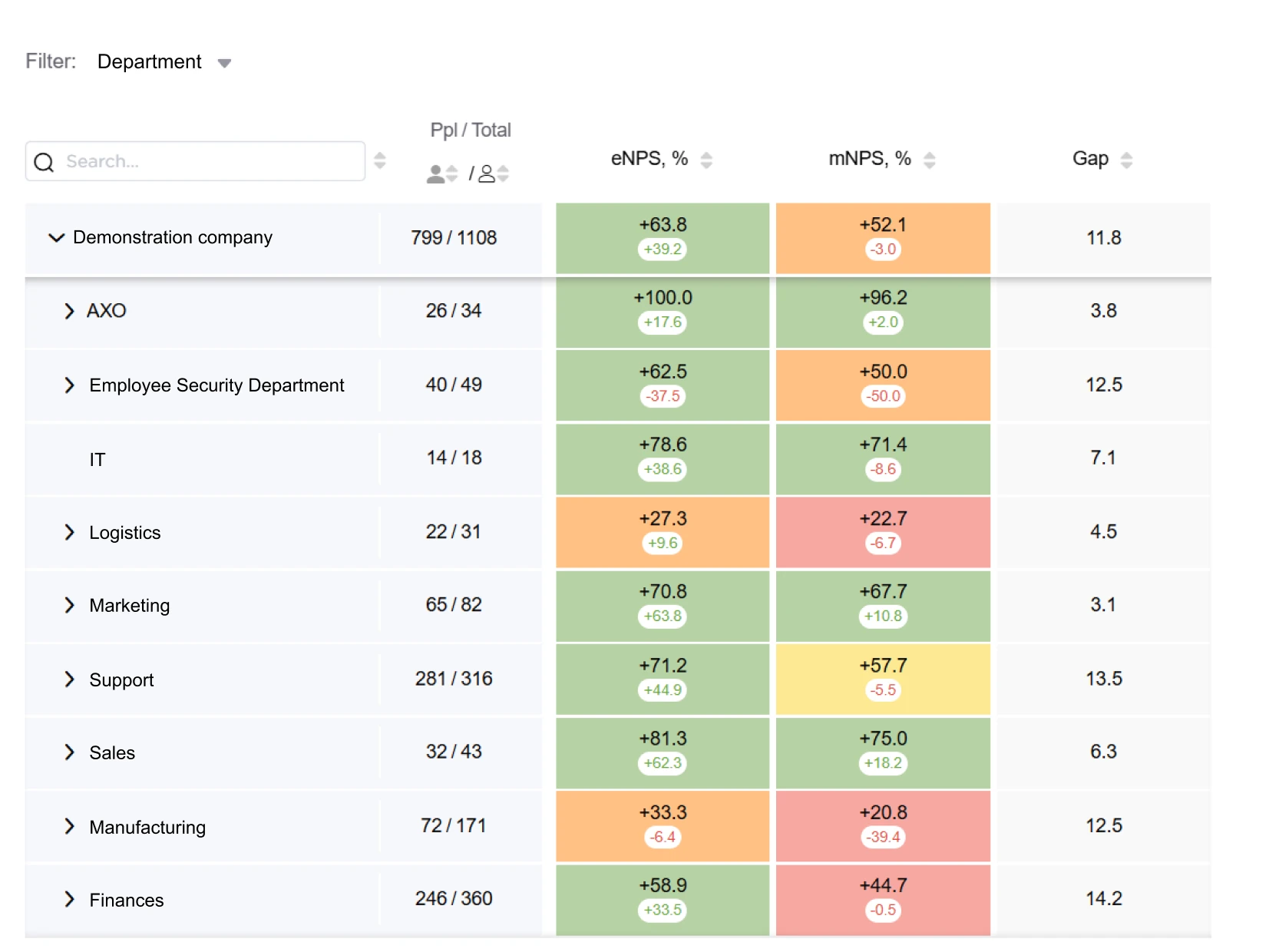
A significant bias toward eNPS or mNPS can cost a company valuable employees, or even entire teams. A difference of 20% or more is considered significant.
Let's consider possible situations in which there is a bias towards eNPS or mNPS.
eNPS exceeds mNPS
when loyalty to a company exceeds loyalty to a specific manager.
Potential reason may be that a company has created conditions for comfortable work, but the line manager has weak managerial competencies. He/she:
- seems to be irrelevant in his/her actions,
- has favorites among subordinates,
- uses double assessment standards,
- gives low-quality feedback, etc.
How to eliminate bias
A manager needs to develop his leadership and management competencies. Additionally, it's worth conducting additional survey: adding a question to employees about the reasons for low loyalty, or launching a survey that will point out weaknesses in the company culture and work environment.
It will be useful to improve the teams’ psychological climate in the following ways, such as to:
- stablish rules that are common to everyone, regardless of the employee’s length of service, his/her achievements, etc.;
- establish a process for regular 1-on-1 feedback within the department;
- maintain staff motivation with frequent and justified praise.
eNPS falls under mNPS
when loyalty to a manager eclipses loyalty to a company
Potential reasons are as follows:
- A company has unsatisfactory working conditions and no growth prospects. Employees are kept from quitting by their loyalty to the manager.
- Manager's words and actions reduce the loyalty of subordinates to the company: for example, he/she criticizes top management, presenting its decisions in a negative light; does not tell subordinates about the goals and strategy of the company; does not inform about important projects and events; undermines changes implemented; does not convey information to employees about their career prospects.
How to eliminate bias
A manager shall do the following such as.
- conducting additional survey: adding a question to employees about the reasons for low loyalty, or launching a survey that will point out weaknesses in the company culture and work environment.
- arranging systematic training for middle managers in the company.
- transferring some tasks that influence employee loyalty to the HR service: for example, informing employees about the successes of the company, the value of the product for customers, the strategic goals of the company, and the changes being implemented in the company.
It is 
to find out what employees
are really thinking
Why to study loyalty to managers
Any organizational change inevitably encounters resistance from staff: people fear that innovations will worsen their current situation and familiar processes and conditions. For this reason, only a small percentage of initiatives are ultimately implemented.
To achieve widespread employee acceptance of any changes, a company must conduct extensive outreach, communicate the goals and results of the reforms, and be open to dialogue at all levels. This task is addressed in practice by managers at all levels, from a CEO to a direct manager.
When a frontline manager or direct supervisor remains silent or pushes back on new initiatives, employees quickly view the change as a threat and will begin to delay their implementation. In subordinates’ opinion, the immediate manager will appear as an honest person defending the team's interests, while the company will appear as an enemy.

Surprisingly a high mNPS, which, along with eNPS, is usually seen as a catalyst for change and innovation, a guarantee of their acceptance by employees, becomes an obstacle to the company's development if a person who is trusted shows signs of disloyalty or is not professional enough to cope well with managerial functions.
Loyalty to a manager is a key factor in the smooth functioning of the team. In practice, this means that the manager:
- builds a productive environment in the department, that is, creates comfortable working conditions, prevents overload and burnout, acts as a facilitator of processes and communications, resists intrigue and unhealthy competition;
- is engaged in the professional development of subordinates, that is, discusses with them professional tracks and career development prospects, recommends training courses and programs, helps to apply the skills acquired in them in work;
- shows genuine interest in their lives, both professional and personal.
But if employees are loyal to the manager but disloyal to the company, the organization is seriously risking its image in the labor market and the integrity of the team.
For example, when leaving, a leader can take the team with him to a new place.
How to adjust mNPS
Based on the results of engagement and loyalty survey, HR can influence mNPS, including filling gaps in staff development that arise as a result of a lack of managerial competencies, ignorance, or deliberate sabotage by managers.
Thus, to fully inform employees about professional development opportunities, a page with current training programs, internships, and open positions shall be posted on the corporate portal, or career consultations shall be provided by appointment on certain days.
For team to familiarize with innovations and changes in the company, the HR with the support of the PR department shall prepare articles for the corporate portal, letters for newsletters, and answers questions that arise in special chats.
However, the HR department is not able to completely replace the manager in matters of working with personnel and solving the business tasks assigned to the department.
A leader can (and should) provide personalized, regular feedback to every employee. HR, even if they wanted to, couldn't provide the same quality of feedback. Depending on the size of the company, there will be hundreds of employees per HR specialist, meaning feedback will remain rare and standardized.
The second reason for the difficulty in adjusting the eNPS/mNPS ratio lies in the area of trust and authority. Employees trust their direct manager more than their functional managers or senior management. Therefore, the actions and words of a manager will have a greater impact than those of an HR specialist.
It is important not to remove managers from performing the functions described above, but to develop their loyalty to the company and teach them the necessary skills.
How to increase the loyalty of middle management
- Launching training programs for management staff, where managers can develop leadership and management competencies.
- Developing mentoring at the highest level: experienced managers should help less experienced colleagues in HR matters - suggest how to motivate the team, give feedback, set priorities.
- Scheduling one-on-one meetings between executives and top management, especially during the implementation of major changes in the company. This will help secure the support of middle management and ensure that they instill confidence in their teams.
How to encourage team’s desire to recommend their manager
If the mNPS indicator drops compared to or along with the eNPS, that is, employees are not loyal to the manager and dissuade friends and relatives from working with him or her, it is necessary to strengthen the manager's trust and authority.
Let's list the available methods, you can:
- establish feedback between the leader and each of his employees: talk about current projects, discuss professional development and career advancement options;
- encourage bottom-up feedback: respond as quickly as possible to employee requests, especially judgments, and look for ways to solve problems;
- improve the mechanism of interaction between subordinates and the manager, which will allow them to ask any questions that they consider important;
- hold regular one-on-one meetings where the manager should explain what employees' salaries are made up of and why they are the way they are;
- make salary and fringe benefits more attractive to employees by using extra vacation days, time off, or the opportunity to work from home a few days a week as compensation for professional achievements;
- allow employees to independently arrange their workplace the way they like it: bring fresh flowers, decorative elements, etc. Working conditions, including the workplace and the office itself, have a great influence on employee recommendations, so it is useful for the manager to listen to people's wishes regarding a comfortable workspace.