

Employee loyalty survey and assessment
What is loyalty?
Loyalty
is an index that gauges an employee’s attitude to the company, his/her energy and willingness to change.A person needs to be aware of himself as part of society, so he is in a permanent search for a group of people who align with their aspirations. Loyalty is a person's reaction to the appearance of a community in his life that meets his social needs.
Types of Loyalty
Employees have two types of loyalty: affective commitment and normative commitment.
Affective Loyalty
is emotional commitment. Employees with such loyalty are committed to the company, identify with it.With affective loyalty, the employee is proud of the organization in which he/she works, connects the future with it, as a rule, supports changes.
Normative Loyalty
is a sense of moral or ethical obligation and duty. It often comes from a habit of living within the organization; a reluctance to quit due to difficulties in finding a new job; a sense of duty to the manager or team.Such an employee usually does not feel genuine pride towards the company and is often unwilling to recommend it as a place to work.
What is the danger of a low loyalty
Low loyalty poses numerous financial risks for a company. Let's look at the main six.
1. Losses from departure of key employees
Low loyalty often leads to increased turnover within a company. The departure of key employees, in turn, is always associated with high costs. These include:
- Costs associated with replacing a resigning employee.
- Costs of recruiting a new employee (when contacting a recruitment agency, this item of expenditure can cost up to three salaries for the position).
- Expenses for training and onboarding a new employee. This item also includes the time of the manager and colleagues responsible for training the new employee.
- Loss of accumulated experience and expertise, which is difficult to assess in money.
- Costs associated with downtime or poor-quality services provided to clients during the period of replacing an employee or training a new employee.
Example:
Direct damage from the dismissal of an employee is six of his salaries, another six are hidden losses.
Imagine the scale of losses if an average of 20% of the staff leaves the company every year. (This rule does not apply to companies where high turnover is normal and is accounted for business processes.)
2. High recruitment costs
High staff loyalty is expressed in the willingness to recommend their company as an employer to friends and acquaintances. Positive recommendations in personal conversations and social media posts can strengthen a company's HR brand. As a result, the cost of attracting new employees will be reduced.
Negative recommendations, on the contrary, will worsen the company's HR brand and make it difficult to hire.
Recommendations apply to employees of all levels and professions. This is especially important for industries and regions with intense competition for talent, where professionals are choosing between three or four companies.
3. Wage budget overpayment by 30% or more
One of the most important facets of loyalty is pride in the company. Brand loyalty is irrational and assumes that employees want to be part of a large, well-known company and contribute to an important, useful product. Factors like satisfaction with compensation or working conditions come second. This allows employees to be paid lower salaries than competitors.
Disloyal staff, in turn, will need to be retained with high salaries – 30% or more higher than competitors.
4. Inefficient waste of investments
Loyal employees are ready to support changes in the company, disloyal employees are not. Employees' reluctance to change is difficult to notice until the changes are implemented. This is the main danger of ignoring the staff loyalty survey.
If there are more or the same number of disloyal employees as loyal ones, the company will face the following:
- All proposals and initiatives will be secretly or openly stonewalled.
- Calls for initiative to improve processes will be left behind.
- Agreement with the changes will be only apparent. You require strict control over the implementation of all project stages.
5. High costs of restoring the operations of key departments
Low loyalty contributes to high turnover, aversion to change, and perfunctory performance of job responsibilities. If these traits are characteristic of staff in key departments, the company can suffer serious losses—loss of reputation and customers due to poor product or service quality. In turn, correcting the situation will cost the company a lot of money.
6. Loss of revenue
Survey shows that high loyal salespeople close 37% more deals than disloyal ones. This is due to their faith in the company's product, a better understanding of its merits, and how it compares to competitors' products.
What factors impact loyalty
Loyalty has four facets. Let's consider each facet and the factors that impact it.
Pride in the company
Pride in a company is the most important aspect of loyalty. It demonstrates employees' emotional commitment to the company. Employees who genuinely love the brand will put in second place rational factors such as salary level or quality of working conditions.
Typically, pride arises when a company has a strong HR brand, plays a significant role in society, or produces high-quality products.
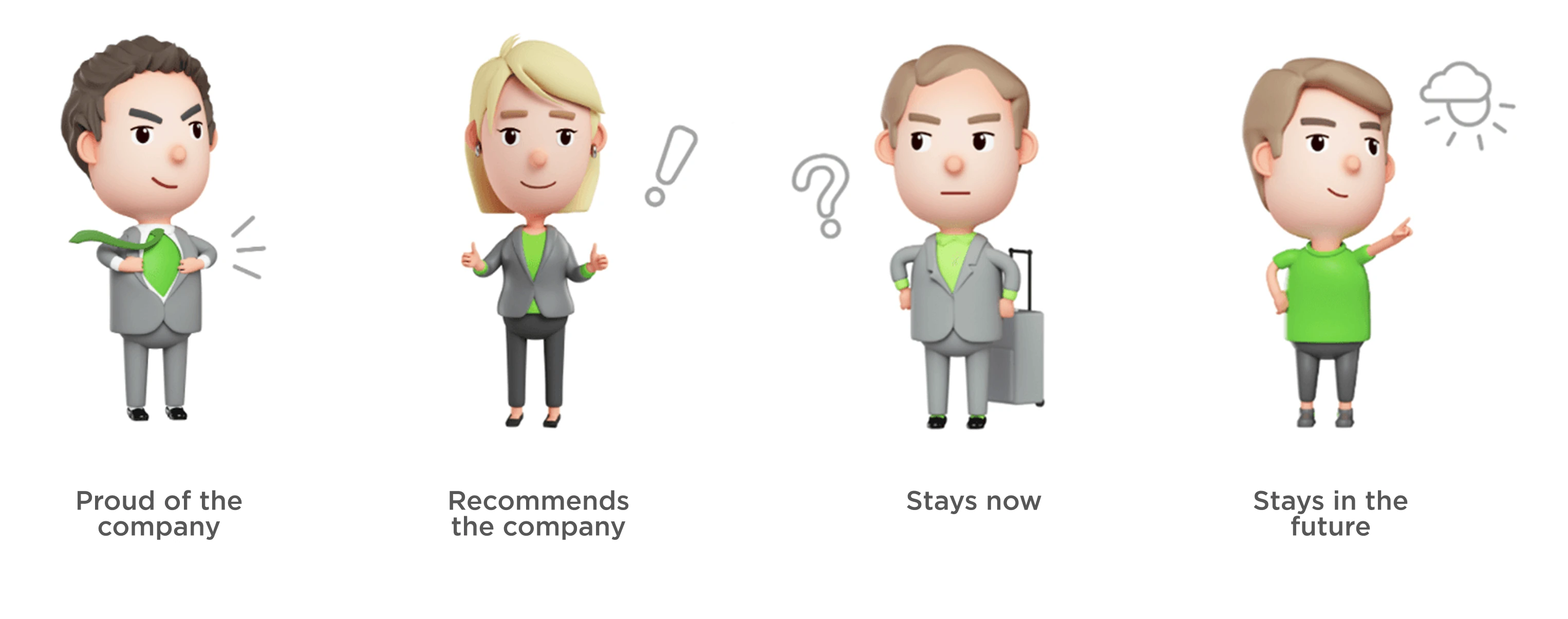
The Happy Job platform uses the Proud of the company metric to assess this factor.
Willingness to recommend the company as an employer to friends
Another aspect of loyalty is employees' willingness to recommend the company as an employer. This is influenced by two factors. The first is satisfactory compensation and working conditions at the company. The second is sufficiently developed managerial expertise in a direct manager, specifically the ability to provide feedback and recognize the achievements of subordinates.
The Happy Job platform uses Recommends the company metric to assess this factor.
No intention of switching jobs
A lack of a clear desire to find another job is also a facet of loyalty. Employees will rarely consider changing jobs if they are currently satisfied with the company's salary and benefits, and if they view career opportunities favorably.
On the Happy Job platform, this aspect is measured by the Stays Now metric. This metric is a powerful driver of short-term employee retention.
Planning to stay with a company for the next few years
Loyalty is measured not by years worked for a company, but by plans to continue working there. Employees will want to commit their future to a company if two conditions are met: they see career prospects for themselves, and the company and its activities inspire pride.
Employees' willingness to work for the company in the next few years is a trigger for long-term employee retention.
The Happy Job platform uses Stays in the future metric to assess this factor.
Employee Loyalty Analysis
On the Happy Job platform, employee loyalty surveys are conducted based on four metrics: "Proud of the company," " Willingness to recommend," "Remaining Now," and "Remains in the future."
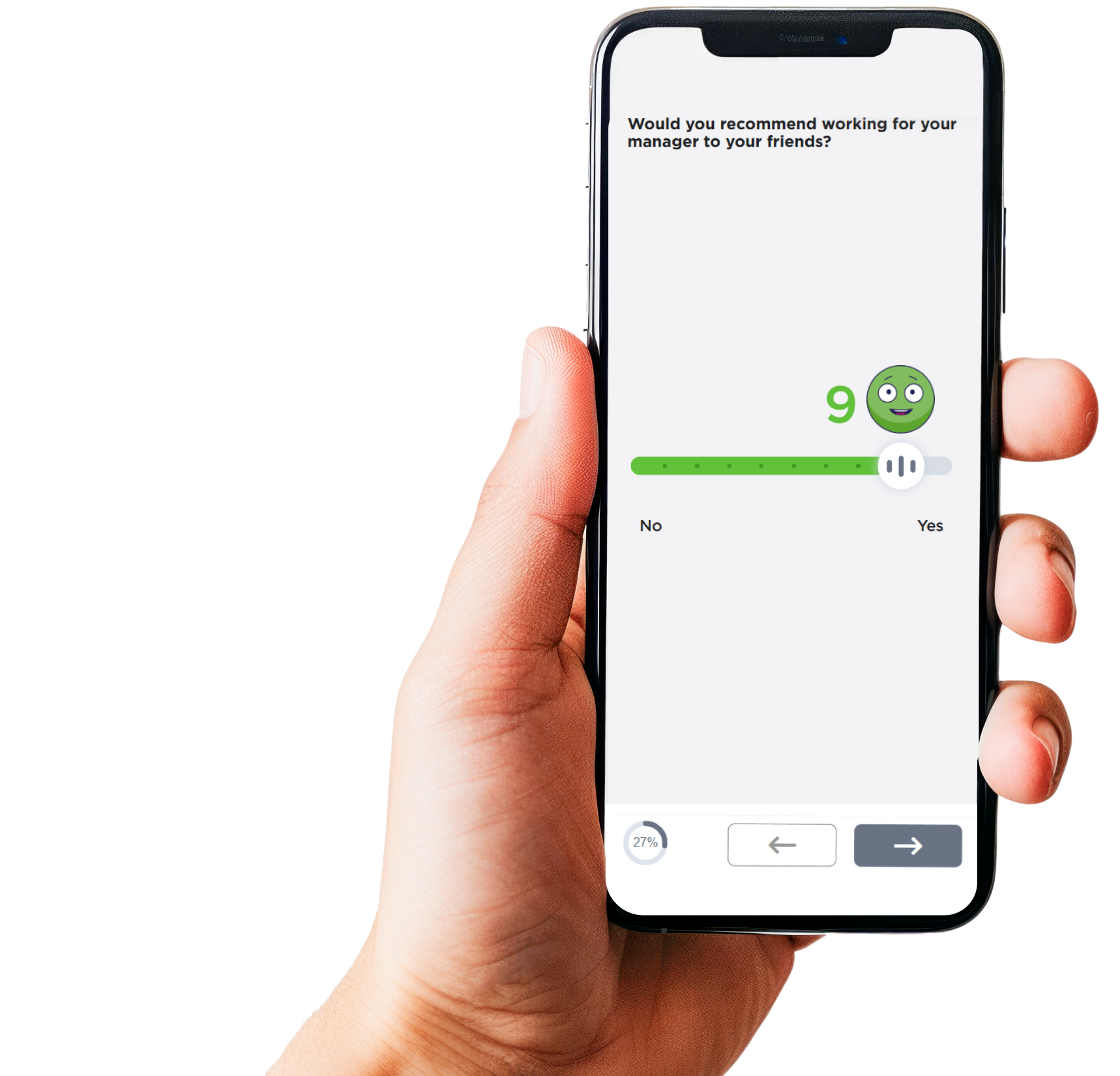
Each metric has its own question. Employees' answers determine a score from 1 to 10. The average score across all metrics constitutes the company/department’s loyalty index.
Gauging Engagement made

Employee groups by loyalty level
Based on the results of the employee loyalty survey, employees are divided into three categories: employees with high, medium or low loyalty levels.

High loyalty employees
This group includes employees with an average metric score of 9 or higher. They are proud of the company and recommend it, support change, and rarely consider changing jobs.
The more loyal people in the team, the stronger the company and the higher the chances of its development and high competitiveness.
Medium loyalty employees
This group includes employees with an average score of 7 or higher, but less than 9. They perform well, but without striving to do more than is required; they will support changes only if the manager convinces them of their necessity.
Low loyalty employees
This group includes employees with an average score of less than 7. They will slow down any changes, formalize any job tasks, and are likely to actively seek a new job.
How to work with each group
You should start working with loyalty from low loyalty employees. A manager should be attentive to their problems and proposals. It's important to ask questions about what's causing dissatisfaction and how the situation can be improved, and implement proposals which might help the team.
Medium loyalty employees are often the largest group and should be the next priority. You should act the same as with the low loyalty employees, namely, find out the reasons for dissatisfaction, collect proposals for improving the situation and implement interesting solutions.
High loyalty employees can be a source of information about what drives loyalty. You should collect feedback from this group regarding company's strengths as an employer. These responds will help you build effective loyalty initiatives with other groups.
Why loyalty to a company is higher than to a manager
Employees will be more likely to recommend a company than a manager if the company creates a comfortable work environment, but a line manager has weak managerial expertise — he/she seems to be irrelevant in his/her actions, has favorites among subordinates, uses double standards in assessment, gives low-quality feedback, etc.
Why loyalty to a manager is higher than to a company
In this case, several options are possible. The first is that the company has unsatisfactory working conditions, there are no prospects for growth, and the only thing that keeps employees from leaving is their commitment to the manager.
Second, manager's words and actions reduce the loyalty of his/her subordinates to the company. This can happen:
- When a manager undermines senior leadership and its decisions or publicly doubts its legitimacy.
- When a manager fails to communicate or miscommunicates company goals.
- When a manager ignores or badmouths organizational changes made.
- When a manager fails to communicate career prospects and neglects employee support using available resources.
You should expect employees to be equally loyal to the company and their manager.
How to increase employee loyalty
The Happy Job platform provides recommendations for improving metrics. Let's take the Proud of the Company metric as an example.
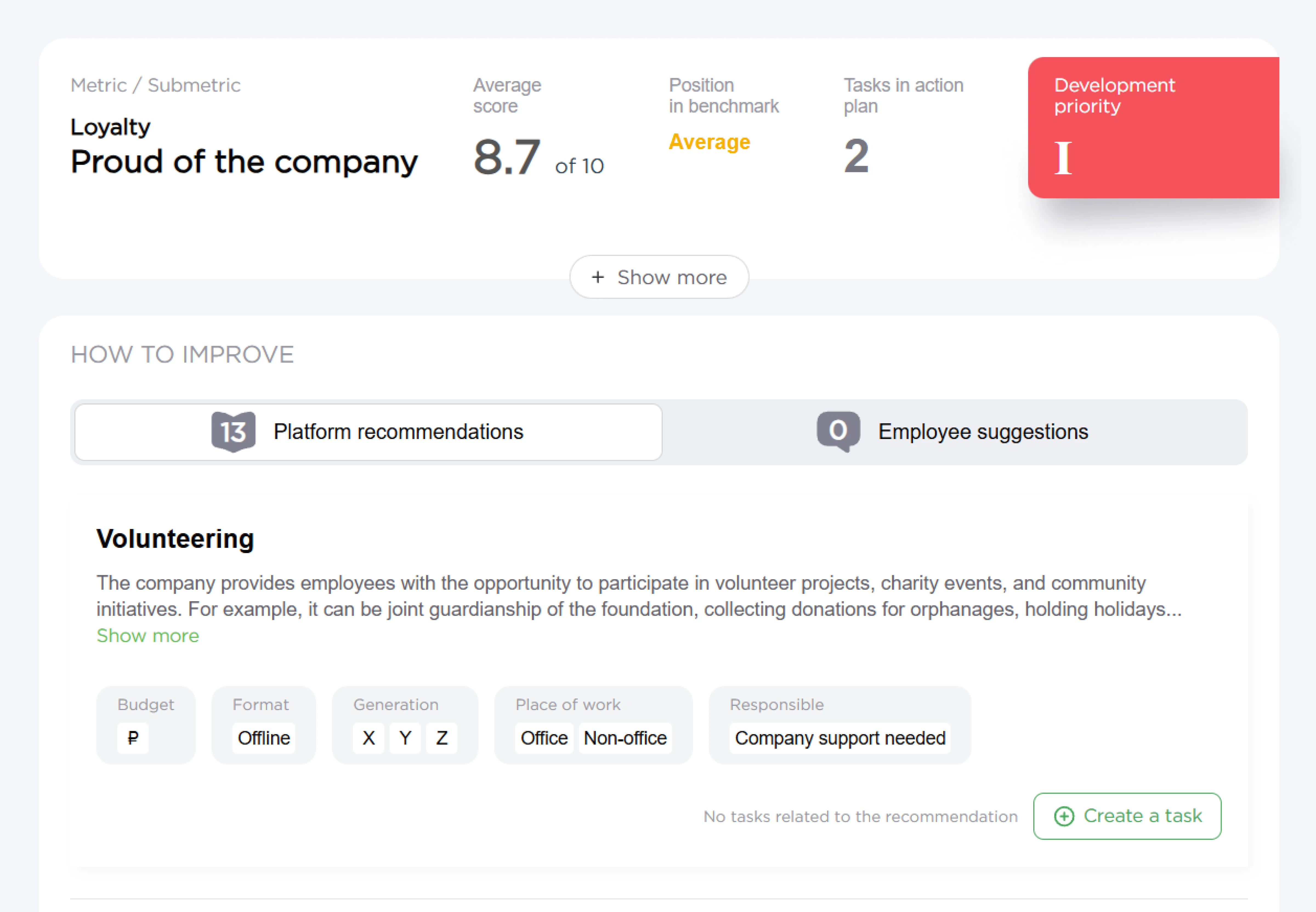
The Happy Job platform offers at least six measures for its development. Specifically, you can start a tradition of recognizing employee successes or highlighting company achievements.
Our platform guarantees loyalty when proposed measures have been implemented.