

Happy
Index
Comprehensive Engagement and Loyalty Index
What is the Happy Index?
The Happy Index is a unique index that has become an evolution of engagement survey technologies. Thank to such index you may identify the company's "golden asset" and define your HR strategy.
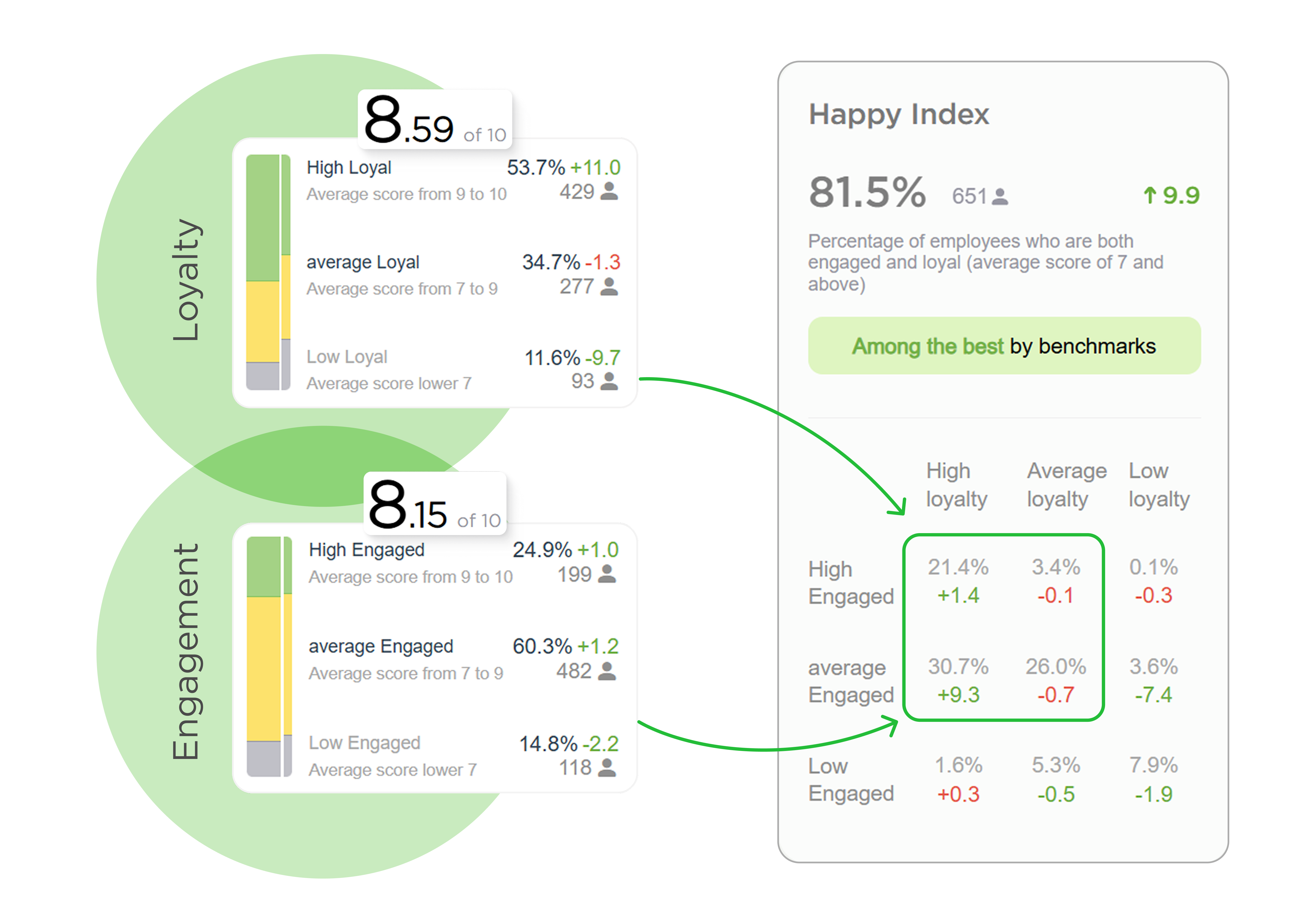
The Happy Index is calculated by summing highly and moderately engaged employees with highly and moderately loyal employees.
Why to use the Happy Index
You can use the index to characterize the relationship between loyalty and engagement. Understanding this relationship allows for an objective assessment of the company's atmosphere and the implementation of solutions and practices that can improve the productivity and business performance of any organization.
An employee may be loyal but disengaged. For example, he/she wants to stay with the company for the next few years, hope for a promotion, and recommend the company to their friends seeking employment. However, he/she does not strive to exceed expectations, perform poorly, and lack initiative.
Or, conversely, an employee may be engaged but not loyal. For example, he/she may be excellent at his/her job and exceeding KPIs, but is planning to leave for a competitor in the near future.
Thus, the loyalty index indicates whether employees feel pride in the company, will support organizational and strategic changes, and will remain loyal to the company even in difficult times.
The engagement index shows whether employees feel their work is a calling and are willing to invest time and effort in professional development. It also indirectly indicates whether the company itself creates a comfortable work environment allowing employees to easily engage in their work.
Loyalty and engagement indices cannot provide managers with comprehensive and accurate information for decision-making. Therefore, a new HR index was needed that would combine both loyal and engaged employees.
Happy Index Matrix
The Happy Job platform allows you to not only gauge the Happy Index, but also divide employees, depending on the results of the loyalty and engagement survey, into 9 groups that make up the Happy Index matrix.
The matrix was generated based on surveys results conducted in the company and allows one to evaluate which groups of employees predominate.
In reports for Happy Job platform users, the matrix looks like this:
How to use the Happy Index
With the Happy Index matrix in hand, a manager can focus on those measures that will improve the situation.
In this case, it is necessary to rely on the personnel policy and the tasks facing the company. For example, if the HR strategy in a company is consumer-based and many employees are low-engaged and low-loyal the following measures should be a priority to develop a productive environment:
- improvement of working conditions;
- operational excellence;
- conducting trainings for managers on managerial expertise;
- frequent, regular and competent feedback;
- recognition of merit;
- conducting 1-on-1 meeting, including discussion of the career path and professional development of each employee;
- events to maintain a healthy work-life balance;
- improving team psychology.
A consumer-based HR strategy assumes that an employee's life cycle in a company is short, so the first priority is to achieve maximum productivity from them.
If an HR strategy is aimed at long-term cooperation, partnership and retention of valuable specialists, the following measures are to prioritize to increase loyalty:
- identifying reasons for low employee loyalty holding proper of 1-on-1 meetings;
- analysis of criticism, ideas and suggestions received as a result of engagement and loyalty surveys;
- joint problem-solving;
- implementing proposed solutions;
- regular meetings with employees to discuss the measures taken and plans for the implementation of further changes with specific deadlines;
- keeping employees informed about company successes, challenges, and management decisions;
- creating workplace traditions and competent, unobtrusive team building.
On our platform, you will find recommendations from our experts to improve your metrics. These recommendations are complemented by a built-in Action Plan and self-monitoring tools helping managers achieve their company's goals without significantly increasing their management workload.