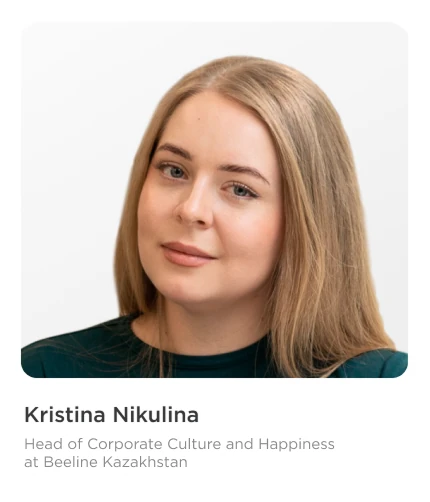
Beeline Kazakhstan is the largest digital operator and the country's leader in subscribers with a team of roughly 6,000 employees. Beeline Kazakhstan has been cooperating with the Happy Job platform since 2023. We talked to Kristina Nikulina, Head of Corporate Culture and Happiness at Beeline Kazakhstan, about how the company works with the results of the engagement survey, why it's important to develop mature attitudes in employees, and not to forget to recognize their merits in a timely manner.

Happy Job: How long have you been assessing and developing engagement?
Kristina Nikulina: it was originally an initiative of Veon, our parent company. Since 2016, Veon has been centrally implementing engagement processes and monitoring the situation in operating companies, including ours, using products from major international suppliers.
In 2018, our company decided to develop its internal Beeline survey system: our HR team had the goal of gauging not only engagement, but also internal CSI, eNPS, and seamlessly conducting various custom surveys. Beeline Survey operated until 2023, and all surveys were conducted through it.
By 2023, the company had over 6,000 employees and was faced with the fact that the current system was not capable of conducting an in-depth analysis of results obtained at the team leader level — we have more than 300 of them, and they often turn to the owners of the process for expertise. It took many resources and delayed the processes. This is how we came to choose the new.Happy Job platform.

Happy Job: What value does your management view as critical strategic lever for engagement?
Kristina Nikulina: Engagement in our company is one of the areas of responsibility of top management. We constantly present our performance indicators both internally and externally as one of our competitive advantages: an engaged team is of interest to both shareholders and headquarters, especially when it is clearly shown, how this factor is reflected in business results and that there is a correlation.
In addition, all people managers see this tool value for working with a team. It is crucial for each manager to constantly stay informed about ongoing changes and realize what their employees want and how to improve their engagement, productivity, and efficiency. All managers at our company have access to their team survey results and understand what management changes need to be made to improve the situation—this is very convenient.
We also use survey results to calibrate our people strategy: if we see red flags, we understand where to focus on.

Happy Job: What loyalty and engagement initiatives have you implemented?
Kristina Nikulina: We have been working with engagement since 2020 and are constantly improving and expanding our initiatives. I should say that we make decisions about implementing any initiative not based on a single survey, but on a comprehensive set of surveys. We have 6,000 employees, and such headcount requires highly targeted operational planning, otherwise any changes are time-consuming, expensive, and large-scale.
In the latest Happy Job survey, our employees indicated, for example, that they have issues with work-life balance, or more specifically, with fitness. This is despite the team is working in a hybrid format, the largest office has a free gym, and the benefits plan allows for employer-sponsored workouts.
Looking under the hood, we realized that people are not complaining about the lack of conditions, but a lack of motivation, energy and time for sports. The Balance metric has declined for the first time this year. In addition, in fact, this is a nice problem to have: it means that employees are doing well with their basic needs at work, and things that are higher on Maslow's pyramid are now coming to the fore. We would like to solve this problem within the paradigm of developing adult-to-adult relationships, so that employees do not wait for someone to organize ideal conditions, and they did not look for excuses, but tried more, found opportunities, sports to their liking and a comfortable training regime.
Happy Job: Fostering awareness and empowering employees to act like adults is a challenging task. What steps have you taken to achieve this?
Kristina Nikulina: As part of the Balance metrics development initiative, we have held a series of educational marathons to explain to employees how to manage their time differently. We're also implementing a project to train employees on AI (Artificial Intelligence): we are working on implementing the Copilot tool and explaining how to optimize routine tasks using Generative AI.
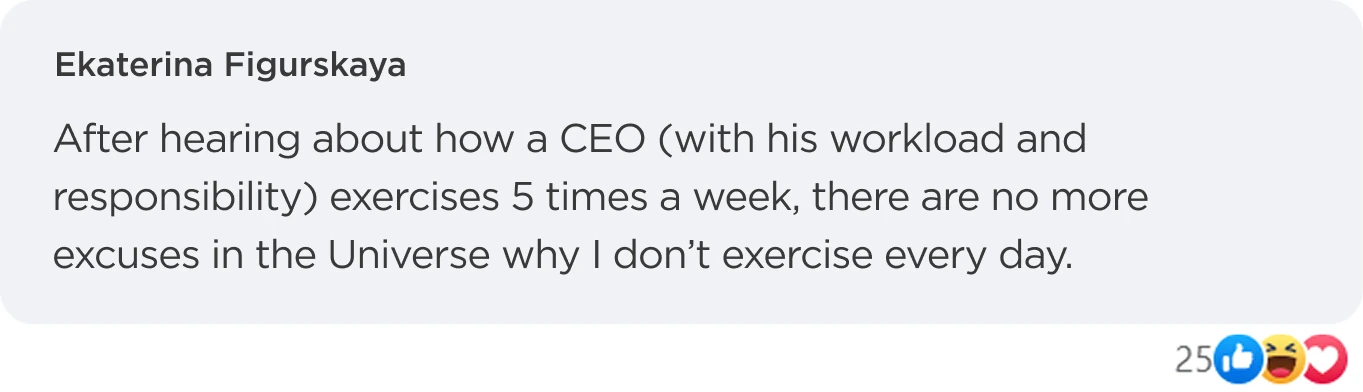
We have a platform called Friday Talk, where every two weeks, top managers go live and share important news, business updates, and more with their team. We suggested adding a section called "Top Managers Share Personal Experiences." The first broadcast was dedicated to how they find time for exercise, so employees could understand that a heavy workload isn't an excuse to neglect their health. After the broadcast, colleagues admitted they'd run out of excuses: if the CEO can exercise five times a week, then they can do it two or three times too.
We also launched a major corporate culture reboot project to develop skills such as self-organization and entrepreneurship in our employees. We're working through communications from top managers and training in the Employee Experience Design methodology for everyone involved with internal services—not just HR departments, but also all support functions, as well as all internal systems support functions. We've dubbed this project "Generation Beeline Doers," as a doer is an action-oriented individual who focus on finding solutions and driving results instead of making excuses or getting bogged down in debates.
An employer must not only create a working infrastructure - provide a person with a desk, a chair, a computer and pay a salary. He/she must support the growth and transformation of each employee. Especially because of artificial intelligence which is rapidly developing and replacing humans in some areas. In doing so, we are already leveling up our people so that they remain in demand considering the further development of technologies.
After receiving the results of the Happy Job engagement survey, we also launched an updated recognition initiative. We are currently introducing new awards to encourage the behavior we want to see, as well as to promote innovation and entrepreneurship across all departments. For example, we want to introduce awards for internal service and an entrepreneurial mindset.

Happy Job: Over the years of conducting surveys, you have noticed positive dynamics in metrics?
Kristina Nikulina: Of course, we used to have dropped in Workflows and Working conditions and Compensations. To improve processes, we systematically implemented Lean (lean production) and Kaizen (continuous improvement) practices over the course of 3-4 years. Now we see that this is no longer a challenge we are facing.
This year, the Working conditions and Compensations metric moved from the red to yellow zone for the first time, which was surprising to us: various experts say that people are always complaining about salaries, and that's natural. But it turned out that's not true: when we worked on financial incentives and the bonus scheme, the situation improved a lot. Therefore, yes, metrics and overall performance improve when efforts are made to address issues in the red and yellow zones.
Happy Job: It's not always easy for management to engage employees with loyalty and commitment. How committed were your managers? How did you motivate them?
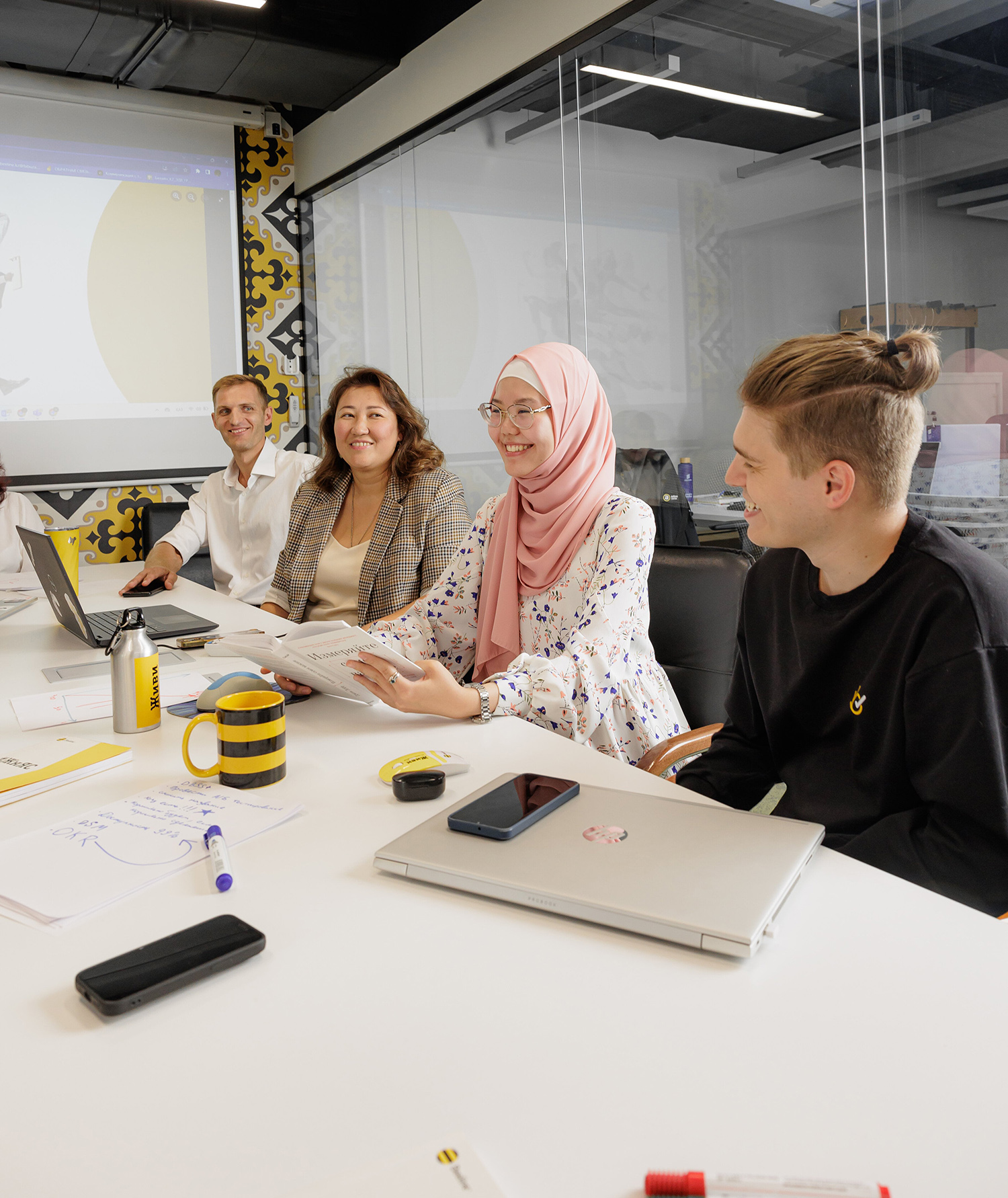
Kristina Nikulina: Yes, this is a rather difficult question. They conceive that these metrics have a direct impact on business success. Top management is actively involved in issues of culture and engagement and communicates all artifacts through tone at the top.
Of course, the management will not have enough time to lead specific initiatives, therefore, we mainly work through HR business partners, competence centers and middle managers. For a person who has up to 100 people in a team, it is much easier, for example, to tell employees about the strategy, explain how it relates to their work, review the workload, etc.
We expect top management to support the corporate culture by our own example. If the management itself sits in the office until 12 midnight, then you should not expect team members to go home on time and maintain a work-life balance when looking at them. We persisted in the belief that our managers are genuine and sensitive being made of flesh and blood.
Happy Job: How you present the results of the survey to the team?
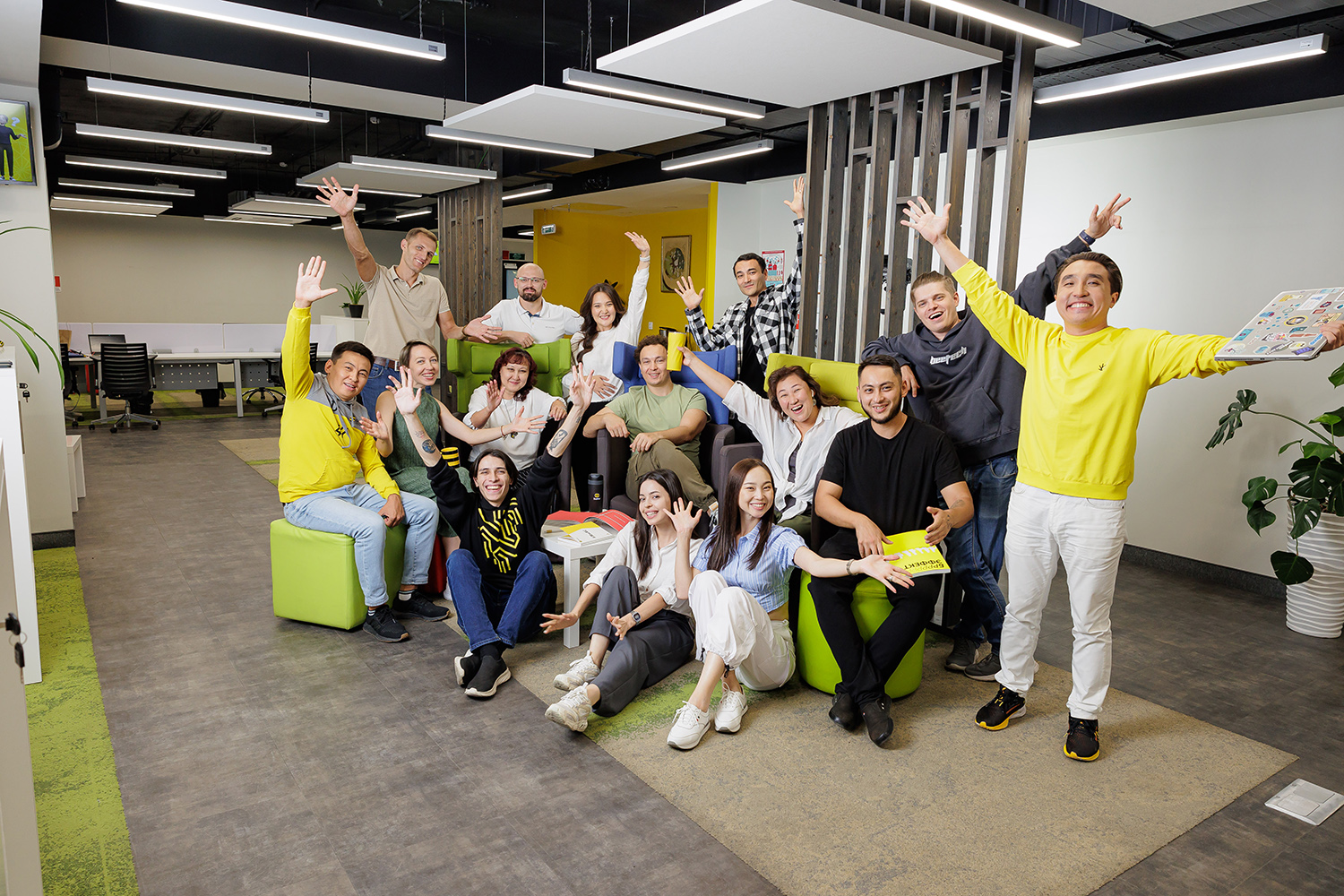
Kristina Nikulina: We show the results of the Happy Job engagement survey to all employees in a group broadcast. We open the charts and say, "Look, we have a bad balance sheet." We do not try to hide the problems and tell you what we did based on the results of the survey. It's also important that the results are presented not by the HR department, but by the CEO and other top managers. Very often, such events are perceived as another HR project, and employees think, "Again, HRs are conducting some kind of surveys." We're trying to avoid this and communicate high-level initiatives through the directors. This helps people feel the importance of the project.

Happy Job: What are the features of working with loyalty and engagement in your industry?
Kristina Nikulina: The telecom industry is one of the most technologically advanced and fastest-growing branches. People got used to the Internet very quickly and want it to be always, everywhere and in the best quality. To meet customer expectations, you need to focus on technology and be among the first to develop and innovate.
All CSPs strive to develop technological departments. For example, we shifted our identity from a telecom operator to a digital operator because in addition to telecom products, we also have our own neobank, our own IT company offering solutions for the external market, our own digital operator, and a range of business products, including Big Data. Last month, we ranked 7th among IT employers in Kazakhstan.
As a multi-business organization, it is important for us to balance the interests of diverse audiences when developing any corporate programs and initiatives. Our company can be roughly divided into telecom, IT, and support functions. Therefore, HR must be able to customize initiatives and act as a consultative Center of Excellence.

Happy Job: Which engagement metrics were your best, and which ones are in the development zone?
Kristina Nikulina: Colleagues and Manager metrics performed best—they were in the green zone. However, the Recognition metric's Frequency and Timeliness submetrics were weak. This means that achievements are recognized, but rather late—at the end of the quarter or half-year. Although these metrics were in the green zone, we felt they could be improved.
This prompted us to train managers on how to give positive feedback and praise employees. We have an ongoing program for middle managers, which includes modules on various types of feedback. We also have an interesting training format called "Managerial Tabletop": managers work in groups to analyze various case studies, including those related to feedback.
We have also realized the importance of recognizing employees' accomplishments at the company level and on behalf of top management — it's a whole new level when you're praised not only within the team but also at the functional unit level. We allocate resources for this, provide recommendations, and develop fair assessment criteria.