

Employee Engagement Survey
What is engagement
Engagement
is an index that gauges the motivation of employees to work toward a result and the productivity of their work environment.For a person to put maximum effort into their work, two conditions must be met: the work must be engaging and motivating, and the external environment must support effective performance. In other words, engagement consists of two components: an employee's internal attitude toward work and a productive work environment.
The work environment is subject to survey. It is assessed through a survey: employees are asked to rate the company's processes, communication methods, and other aspects. Our approach allows to assess 40 work environment parameters through 40 questions.
Why Companies need to develop engagement
Often, specialists confuse engagement and loyalty: a loyal employee is credited with the qualities of an engaged employee, and, vice versa, an engaged employee is credited with the qualities of a loyal employee.
Loyalty
is an index that gauges an employee’s attitude to the company, his/her energy and willingness to change.A loyal employee may not be highly productive, while an engaged employee may not share the company's values. These are related concepts, but still distinct. High engagement, in turn, provides the company with economic benefits: the employee maximizes their experience, skills, and time to complete tasks faster and more efficiently.
Let's look at examples of work engagement:
- Using a creative approach to problem solving.
- Seeking mutual understanding with colleagues to complete work faster and better.
- Expanding horizons when searching for clients or partners.
- Attention to customer needs both external and internal.
- Professional development.
- Desire to optimize own work.
- Leadership role during brainstorming.
Creating conditions for productive staff doesn't require significant investment. In turn, engaged staff produces results equivalent to those of a larger, disengaged team or one with additional motivation.
What are the consequences of a low gauge
If you do not conduct engagement surveys from time to time to assess the productivity of the work environment, you may miss factors that hinder your employees' work. A decrease in productivity poses various risks to the company. Let's consider the main ones.
Financial risks
There are at least two financial risks: a decrease in revenue and an increase in production losses.
Customer disloyalty and reduction in yield
Low engagement leads to falling sales and rising costs. A contract survey by Happy Job compared the results of two departments with a 7-percentage point difference in engagement. The department with the worst performance lost 26% more customers. Customers complained through the feedback form about employees' indifference and their inability or unwillingness to present the product.
Another study by Gallup found that up to 50% of disengaged employees are unaware of product features and differences from competitors' products. Engaged employees, on the other hand, are 25% better at satisfying customer needs, thereby generating 20% more profit for the company.
Increased production losses
People who demonstrate high engagement are not only more effective at completing tasks, but also less likely to make mistakes. Gallup's research demonstrates that low engaged employees are 21% less productive, 41% more likely to make mistakes at work, and 48% more likely to be victims of workplace accidents.
Low employee engagement affects
Low employee engagement may result in detriment to company's operations that are difficult to assess but create problems.
- Enormous control. Managers will be engaged in supervising subordinates, rather than making important decisions or developing the potential of teams.
- Lack of self-sufficiency. Only the top management will have powers; middle management and minor staff will not.
- Lack of trust. Instead of working, people will be busy sorting out their relationships. This will inevitably impact the quality of teamwork and employee initiative.
- Prioritizing the manager's opinion over the customer's needs. Staff will try to please the manager rather than the external customer. This will reduce the quality of customer service or the production.
- Bureaucracy. The problems described above will result in a bloated reporting system and poorly streamlined processes.
What factors impact engagement
Employee engagement is impacted by such parameters as work environment and personal motivation to work.
Work environment
The work environment encompasses all the conditions under which employees perform their duties. The work environment includes several dozen components such as processes, manager competencies, employee feedback on current tasks, interaction with colleagues, corporate culture, and more. If each work environment element helps employees perform their tasks as efficiently as possible, employee engagement will increase.
What an engagement survey looks like
engagement and satisfaction questions
special questions, including managerial mNPS
large survey questions
- All Office Workers
- Production
- Retail
- Logistics
- Pharmacy and medicine
- Development
- Air and rail transportation
- Oil, gas, energy
- A comprehensive 47-question survey covering all aspects of the office work environment.
- A shortened 30-question survey customized for non-office work and supplemented with the occupational health and safety module.
- A shortened 30-question survey customized for non-office work.
- A shortened sector-specific 30-question survey.
- A shortened sector-specific 30-question survey.
- A shortened sector-specific 30-question survey.
- A shortened sector-specific 30-question survey.
- A shortened sector-specific 30-question survey.








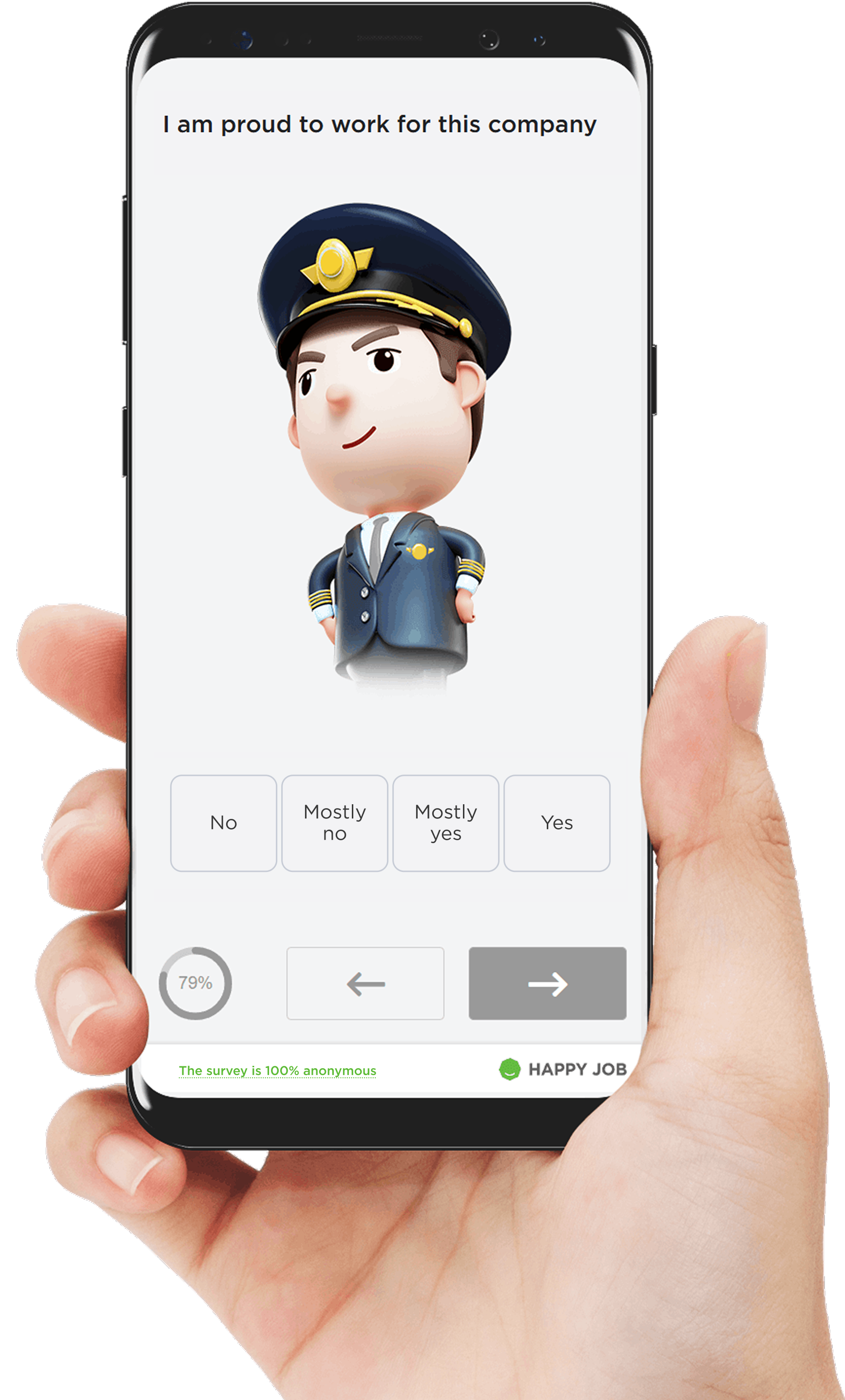
Engagement metrics
Let's look at 10 factors that are most closely linked to high employee productivity and are surveyed using the Happy Job approach.
 Manager and his/her managerial skills
Over 50% factors that impact employee engagement are related to actions, behavior, and performance of a direct manager.
A good manager transforms into an inspiring leader by fostering trust and climate of confidence in his department. He sets clear tasks and organizes short, effective working meetings so that employees can be maximally involved in their tasks and minimize distractions. Such a leader sees and appreciates the unique abilities of his subordinates and knows how to use them effectively for the benefit of the department and the company.
The Happy Job platform uses the Manager metric to assess this factor.
 Awareness of the company strategy
Engagement arises when employees recognize the value of his/her work. The scale of their contribution and the true benefit can only be assessed if they understand what the company does, for whom, and its overall purpose. According to several studies, organizations whose employees understand and support their department's strategy spend, on average, 79% fewer resources to achieve the same results.
A manager will allow subordinates to see the “big picture” if they talk about the company’s strategy, as well as the department’s goals and objectives for at least the next year.
The Happy Job platform uses the Strategy metric to assess this factor.
 Merit recognition
Employee recognition and work engagement are closely linked. Regular, well-founded, and, importantly, sincere praise from a manager motivates subordinates to repeat their successes. A lack of praise, on the contrary, demotivates them. Such effect is provided by dopamine - hormone and neurotransmitter.
Scientific research over the past 20 years has attributed dopamine's important role in reinforcing conditioned reflexes: in case the expectation of a reward is met, the brain releases the hormone. When the reward expectation is not met for a period of time, dopamine production ceases, and the reflex fades. If an employee is praised for a result, they will try to repeat it in order to receive further recognition and experience a surge of dopamine.
The Happy Job platform uses the Recognition metric to assess this factor.
 Feedback from a manager
Performance feedback helps employees recognize their value as specialists and team members, and grow professionally, making it an important engagement management tool. Improving engagement without employee feedback is a waste of resources.
It's not just the fact that feedback exists that matters, but also its form and content. Research shows that employees who receive encouraging feedback are four times more engaged than those who only hear criticism from their manager or receive no feedback at all.
The Happy Job platform uses the Feedback metric to assess this factor.
 Workflows
Productive work can only be achieved if processes are streamlined within the department and company. Clear procedures, requirements, and boundaries of responsibility influence the intellectual engagement of each individual, their desire to improve the work, and the customer focus.
If an employee, while doing his job, struggles with absurd demands, the slowness of colleagues from other departments, or a lack of resources, his productivity will drop to the standard minimum.
The Happy Job platform uses the Workflows metric to assess this factor.
 Conditions for implementing changes
Companies must constantly introduce new products and explore new directions to remain competitive. Successful change implementation depends on two factors: acceptance of changes by the team and the availability of conditions for their implementation, that is, technologies and culture of project management.
Organizational barriers can become an insurmountable obstacle to the implementation of changes, as a result, processes will not develop, new products will not be launched.
The conditions for implementing complex, atypical projects on the Happy Job platform are assessed using the Change metric.
 Career prospects
Job options available within a company is a key factor in employee motivation and engagement. Survey figures that the inability to build a career provokes low productivity in 55% of employees. Career prospects are also among the top three factors responsible for employee retention, as the lack of career growth prospects is the main trigger for dismissal.
When employees understand how they can advance their careers within a company and see examples of how their efforts are rewarded, productivity and a desire to grow within that company increase.
The Happy Job platform uses the Career metric to assess this factor.
 Human relations
Trusting relationships between employees, shared views, a desire to follow corporate rules of conduct and business communication standards, to help colleagues, and to actively participate in teamwork are signs of an engaged team.
Such teamwork conditions guarantee employees a safe environment for open discussions of problems and their solutions, creative exploration, and support from colleagues in word and deed. All of this directly impacts the productivity of the department and each employee.
The Happy Job platform uses the Colleagues metric to assess this factor.
 Work-life balance
According to statistics, poor work-life balance is one of the top three reasons for leaving a job. Furthermore, stress caused by overwork can accumulate and lead to employee burnout—emotional and physical exhaustion, depression, insomnia, and extreme productivity loss.
Survey figures that no-overtime in a company can make staff at least 40% more productive and prevent burnout.
The Happy Job platform uses the Balance metric to assess this factor.
 Compensation and working conditions
Working conditions in a company can undermine engagement. For example, according to survey, an uncomfortable office temperature reduces productivity for 71% of employees, while a low temperature reduces productivity for 53%.
Such factors are commonly referred to as hygiene factors: they only impact work engagement when they are negative. For this reason, it's advisable to begin improving engagement by addressing the negative impact of working conditions or inadequate pay.
However, if employees are satisfied with their working conditions and salary, further improvement of these factors alone will not lead to a significant increase in engagement.
The Happy Job platform uses the Compensation and working conditions metric to assess this factor.
Employee internal attitude
In addition to the work environment, employee engagement is also influenced by their own attitude. Typically, this includes a passion, personal ambition, a desire to contribute, and so on.
A productive work environment in a company has a positive impact on an employee's personal productivity. A corporate culture focused on staff development, quality feedback from management, a friendly atmosphere in the team, and other factors can instill in people a desire to grow and contribute to society.
A critically unproductive environment will harm an individual's personal productivity. An engaged employee will feel uncomfortable among mostly uninvolved colleagues, he/she will stick out like a sore thumb. His/her energy will be spent on overcoming work problems, confronting general indifference. Therefore, as a result, he/she will either adopt the “working style” of colleagues, or leave the company.
Employee Engagement Assessment
The Happy Job methods and approach allow you to assess the productivity of your work environment. To do this, employees are asked 40 questions, grouped into 10 metrics with submetrics.
How to gauge the engagement on the Happy Job platform
Employee responses during the survey form a score on a scale of 1 to 10 for each submetric. Next, we calculate the value for the metric for each respondent as the average value for the submetrics averaging the obtained values for respondents by metric. The average score for all metrics determines the engagement index.
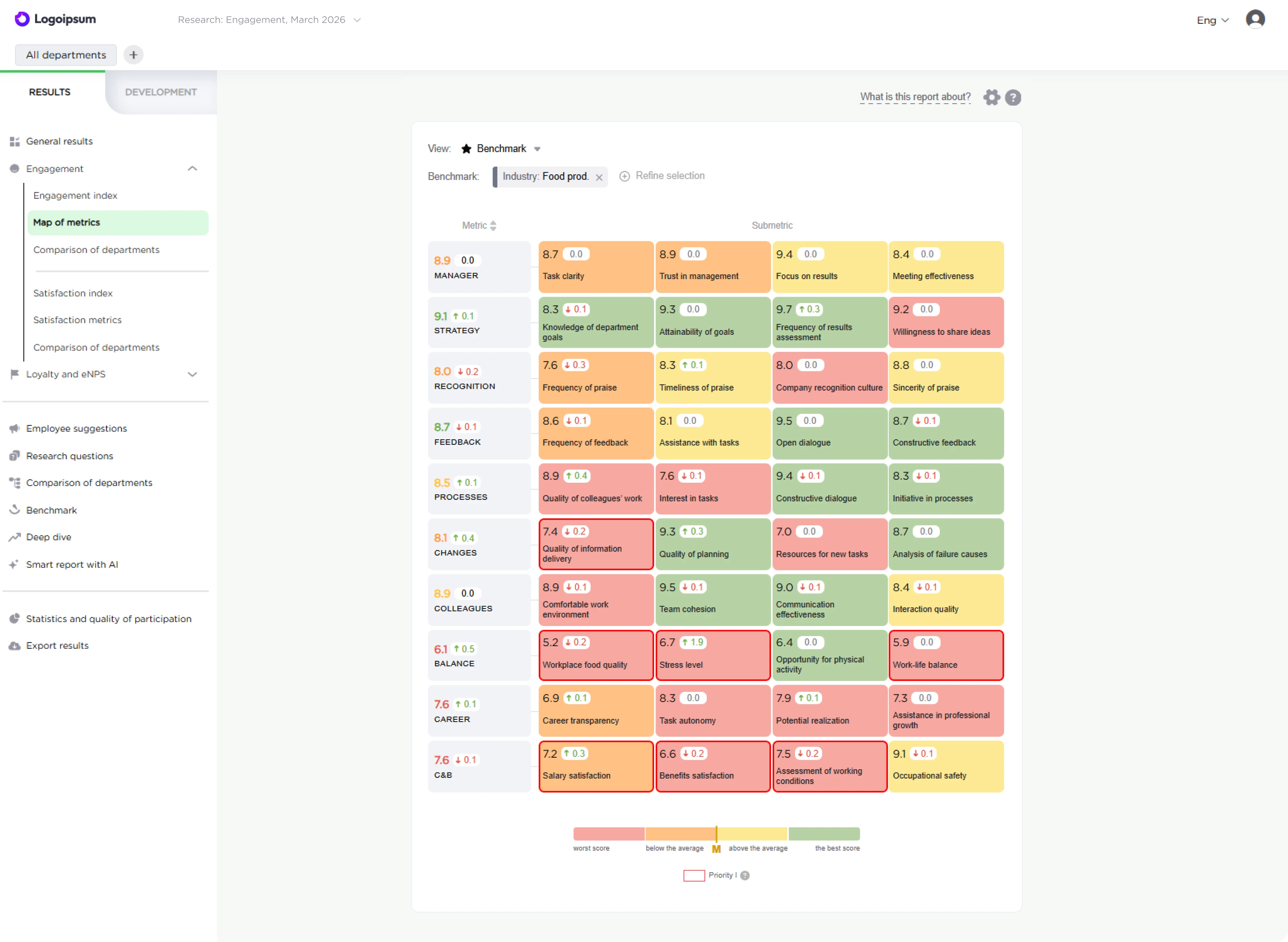
Happy Job Engagement Metrics Map
The metrics map is the platform's main tool for gauging and developing engagement. In online mode, you can observe metrics, submetrics and the dynamics of their changes in the company. More detailed information is also available: departmental data, metrics issues, “development zones” and industry benchmarks.
Examples of questions to assess engagement
- Does your direct manager set clear goals and tasks for you? (Metric: Manager)
- Are you aware of the key goals and action plan of the department for the coming year? (Metric: Strategy)
- How often does your direct manager praise you for a job well done? (Metric: Recognition)
- Does your direct manager provide you with the opportunity to speak up when discussing your work results? (Metric: Feedback)
- Have you proposed any ideas for process improvement in the last 3 months? (Metric: Workflows)
- In case of any changes in your company, is the necessary information communicated to you in full? (Metric: Changes)
- Do you feel comfortable working with your colleagues? (Metric: Colleagues)
- Do you have the opportunity to eat healthy at work? (Metric: Balance)
- Are you aware of the criteria required for your promotion? (Metric: Career)
- How would you rate the salary level for your position? (Metric: Compensation and working conditions)
How to gauge engagement: step-by-step guide
PR campaign before the survey
The preparatory phase of an engagement survey is a crucial part of the process, largely ensuring the success of the entire event. Reliable data can only be obtained if at least 61% of employees participate in the survey. To meet this rather high threshold, a PR campaign is necessary: explain to employees the purpose of collecting feedback and how it will be used.
We have provided templates for successful communications that allow you to convey the purposes of the survey, assure confidentiality of participation, etc. You should conduct a PR campaign in advance to prepare employees for the survey.
What to bet on in a PR campaign and how to deal with employee objections:
- • You personally influence change in the company. Your comments help management identify problems and resolve them quickly.
- • Survey results will not be used for personnel decisions.
- • Survey results are completely anonymous (only aggregated data), there is no risk of damaging relationships with anyone, and it is impossible to identify the person who left the comment by IP address, phone number, email, etc.
- • Based on the survey results, a report will be created with an action plan and a list of changes.
Setting up survey parameters
At this stage we integrate the department structure into the survey, collect contacts for sending links, determine the frequency of mailings, and add questions.
Survey automation
The survey process itself is also automated: on certain days, staff receive links to online questionnaires. Algorithms include communications before, during, and after the survey, as it's necessary to remind people of its purposes, the need to complete the questionnaire, and other details.
Processing results
After the survey, the information is transferred to the server for subsequent analysis and reporting. Managers can view the reports and anonymized employee comments in their personal accounts. Each metric is accompanied by explanations and professional recommendations.
A built-in action plan allows managers to add activities to develop team engagement and loyalty, while remaining mindful of the need for implementation. A key feature of our platform is its foundation, HR Zero, which means managers don't need specialized knowledge to understand reports and plan actions to improve performance. HR specialists, in turn, are assigned the role of consultants and organizers.
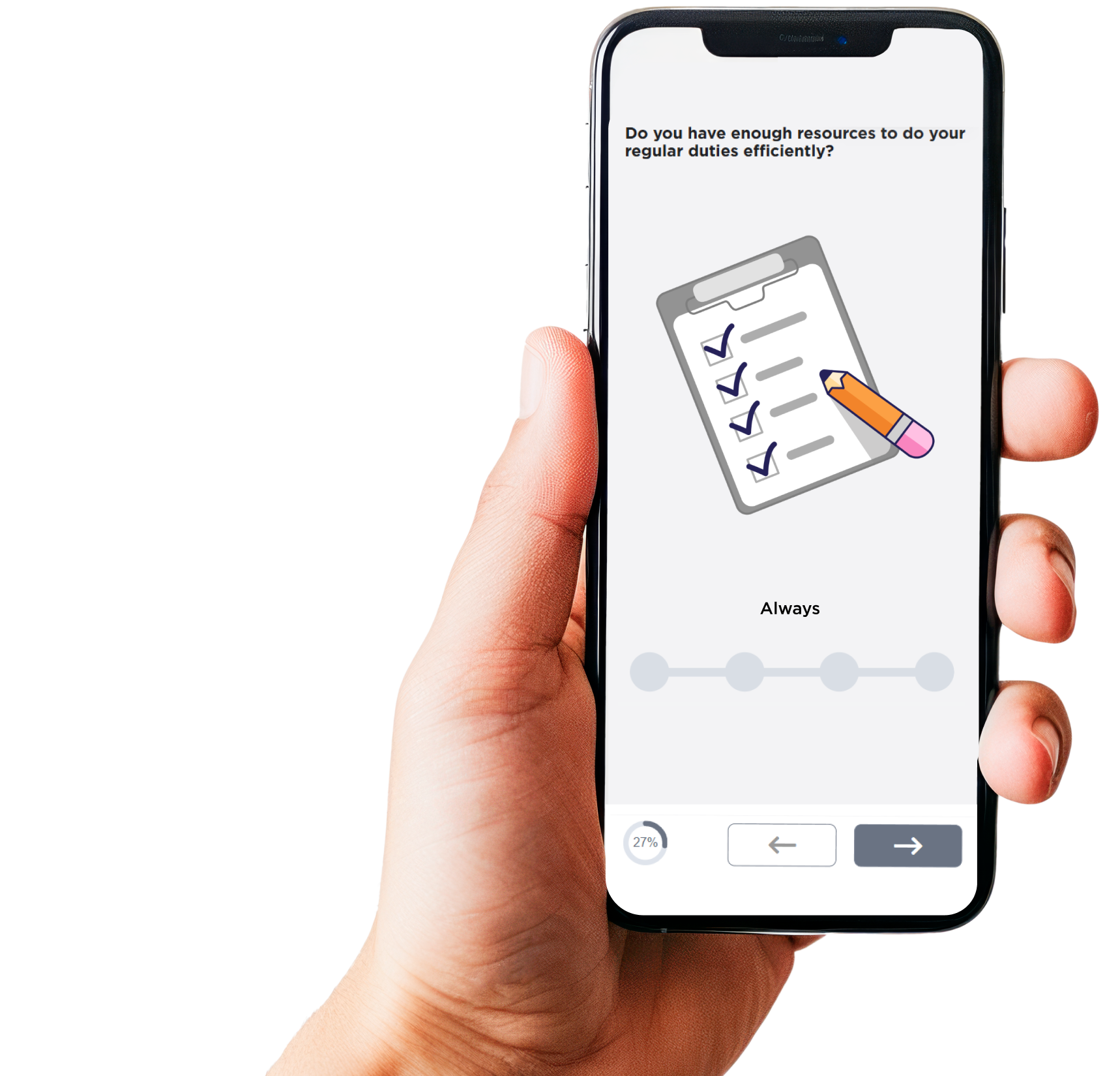
Gauging Engagement made

Employee groups by engagement level
Based on the results of the employee engagement survey, employees are classified into three categories: employees with high, medium, or low engagement levels.

High engagement level (actively engaged)
This group includes employees with an average score of 9 or higher. They typically demonstrate high task performance because they work in conditions that are optimal for productivity.
Medium engagement level (not engaged)
This group includes employees whose average score is 7 or higher, but less than 9. They are interested in the work process, but certain aspects of the company's life hinder their productivity
Low engagement level (actively disengaged)
This group includes employees with an average score of less than 7. They are poorly motivated and underperform in an unproductive environment.
How to increase employee engagement
The Happy Job platform provides recommendations for improving performance for each submetric.
Let's take the Stress submetric of the Balance metric as an example.
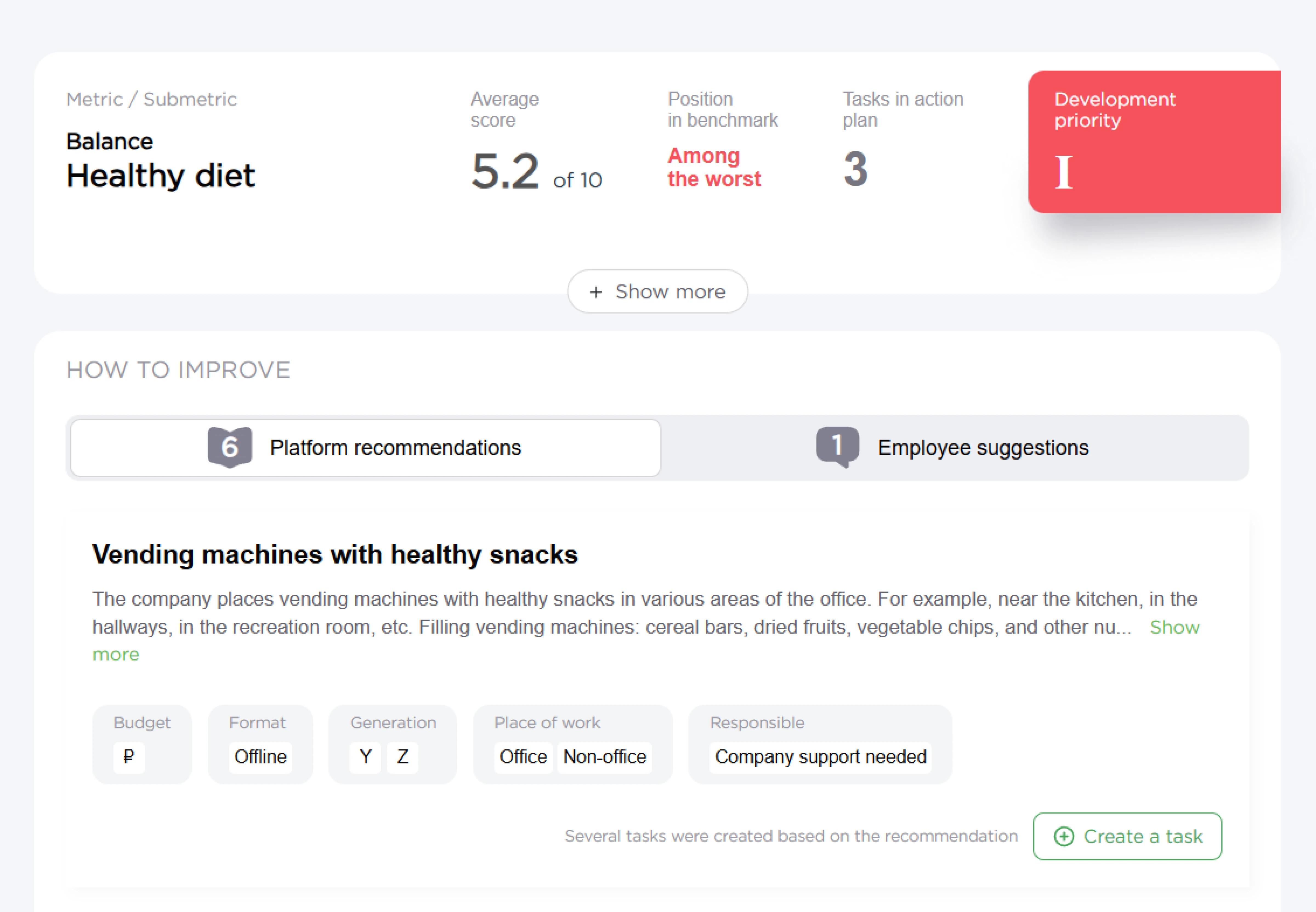
To improve this aspect of the work environment, you can implement six measures suggested by the Happy Job platform. For example, explain to employees how to properly praise colleagues or make it a rule to publicly recognize employees' professional achievements.
By implementing the measures proposed by the platform, employee engagement can be significantly increased.

We also implemented a management monitoring and motivation tool—Action Plan 2.0. This is a free HR task planner integrated into your personal account.
Frequently asked questions about employee engagement surveys
Surveys should be conducted twice a year. This frequency is due to the fact that the company will need time to create a measurement plan and implement it.
The Happy Job questionnaire contains 47 questions (for office employees), based on a proprietary approach, covering all aspects of the office work environment, allowing managers to gain a comprehensive picture of company engagement. The questions are grouped into 10 metrics with submetrics. For non-office employees, a shorter 30-question questionnaire with industry-specific settings is available.
To get a complete picture of engagement, three types of questions should be used: open-ended (for detailed answers), closed-ended questions (yes/no, agree/disagree, etc.), and multiple-choice questions. We've also provided a separate field for free-form comments on the Happy Job platform.
The questions we use on the platform have proven their effectiveness, and 90% of Happy Job clients use them without modification.
The accuracy of the results is 99.5%, so you'll always receive reliable data on your company's situation. Scientific articles based on the Happy Job approach are regularly published in international journals of fundamental and applied research. You can take a view of our consultants' expert articles in reputable business publications. We do not recommend changing questions, as this may affect the reliability of the data.
Classic questions according to the Happy Job approach can only be adjusted dabblingly without changing the number of answers, the type of question, and the meaning thereof.
Happy Job server anonymizes employee data. The company will obtain only a summary of results, and the reports do not contain the full names of employees. The results of units in which less than 5 people have completed the survey is completely hidden from the company.
The Happy Job platform allows you to process the results of up to a million participants in an engagement test.
Anonymity is one of the platform's priorities and the main condition for conducting surveys. Experience shows that an open questionnaire is practically useless as employees begin to respond insincerely, demonstrating “visible loyalty”.
Each industry has its own good engagement rates. The Benchmarking tool will help you determine whether you have good results or not. Analytics for benchmarks is available by industry, region, and job functions of employees. Compare your performance with your competitors and find out which aspects to focus on first.
No, this is our basic point. Our goal is to help establish a comfortable dialogue between employees and the employer. By answering anonymously, workers are not afraid to be honest, and their answers reflect the real state of affairs. If a company has any problems, an anonymous survey will help identify them more quickly and find solutions.
The Happy Job platform supports integration with most engagement measurement providers. Request a consultation with a Happy Job specialist to determine if your data is compatible with the platform.